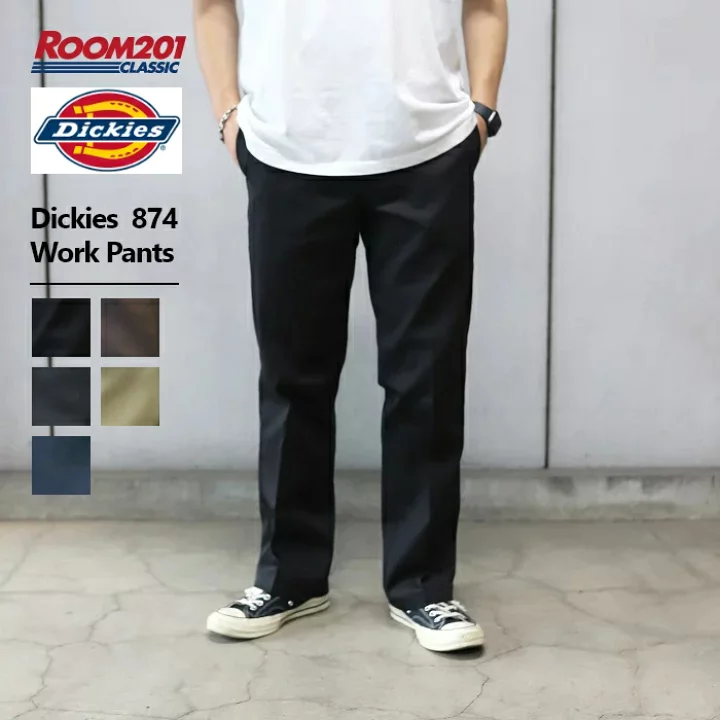
Written by: Jin Fujisaki / Published: 2026-02-12
Have you ever worn chinos or slacks only to find them stretched out at the knees or hopelessly wrinkled? "Clothes are consumable, so it can't be helped." If that's what you think, you should try Dickies, born in 1922 in Texas, USA.
Texas back then was in the middle of an oil boom. The workers — covered in oil, wrestling with sharp metal and rough rock surfaces — weren't asking for style. They wanted "absolute, unbreakable toughness." The pants developed in response to that demand, and finalized in their definitive form in 1967, are the "874." More than just trousers, they're closer to a piece of "equipment" designed to protect your lower body.
| The Magic of the Golden Ratio: "65% Polyester, 35% Cotton"

image Rakuten
The biggest defining feature of the 874 lies in its proprietary fabric known as "T/C twill." 65% polyester, 35% cotton. This blend ratio is the golden ratio of durability that Dickies discovered.
It retains the soft hand-feel of cotton while adding the powerful durability and quick-drying properties of polyester. On top of that, the surface is treated with "Scotchgard," a stain-repellent finish, so even when mud or oil gets on them, simply tossing them in the washing machine cleans them up with surprising ease. They breathe well too — cool in summer, warm in winter. It's truly a high-tech material made for the working man.
| The Mystery of the "Center Crease" That Never Washes Out
image ROBLES
What surprises people most when they wear the 874 is the sheer resilience of the center crease. With ordinary slacks, the crease vanishes after a single wash and you have to iron it back in.
But the crease on the 874 comes back as if made of shape-memory alloy, no matter how many times you wash it. Even tumble drying won't kill it. Which means no matter how casually you treat them, the moment you slip them on, you radiate a "crisp, clean look." You can erase the chore of "ironing" from your life entirely.
| Brand New, They're as Stiff as "Cardboard"
image Magaseek
Anyone buying the 874 for the first time may be taken aback by how stiff they are. The starch is so heavy that, set down on the floor, the pants alone will practically "stand up by themselves." The fit feels rigid at first, and you might find them hard to walk in.
But this, too, is by design. As you wear and wash them a few times, the starch comes out, the fabric softens, and they become astonishingly easy to move in. The process of "breaking them in to your own shape" is the same as with Levi's jeans or Red Wing boots. Armor at first — eventually, a second skin.
| The "Won't Tear When You Wipe Out" Trust That Skaters Loved
image SANKO BAZAAR
Originally a work uniform, this pant exploded in popularity somewhere else entirely once the '90s rolled around: the streets. They didn't tear when you bailed on a skateboard, they were cheap, and they were easy to move in. That practicality was discovered by skaters and punk rockers.
Pick a slightly larger (oversized) fit, and wear them low on the hips. That became the uniform of street fashion back then — and still is today. Wear them as workwear, wear them as fashion. However you wear them, the 874 will carry your style.
| Conclusion: The Soul of America for 6,000 Yen
image e-begin
The current price in Japan is around 6,000 to 8,000 yen (parallel imports can be even cheaper). They cost a bit more than Uniqlo chinos, but factoring in their durability, the cost performance is overwhelming.
"I've got dirty work today." "I'm worried about mud splashes from the rain." On days like that, reach for the 874 without hesitation. No matter how filthy you get them, you can throw them in the wash that night, and by the next morning they'll be dry — with that razor-sharp center crease standing tall again. Clothes you don't have to baby. Isn't that the greatest luxury a man can ask for?