Written by: Jin Fujisaki / Published: 2026-02-09
Have you ever tried to jot down an appointment on a wall calendar, only to find your ballpoint pen suddenly stopped working? Or tried taking notes while lying down and looking up at the ceiling, only to have the ink cut out?
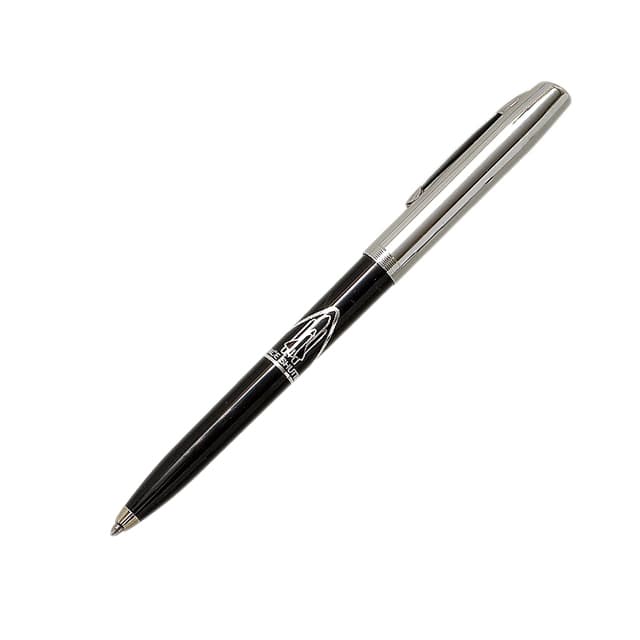
Ordinary ballpoint pens rely on gravity to feed ink down to the tip. So naturally, when you point the tip upward, the ink flows backward and the pen stops writing. But a pen developed for astronauts—who need to write not just on Earth but in "space"—plays by entirely different rules. That pen is the "Fisher Space Pen," developed by American inventor Paul Fisher.
| The Famous Joke, and Why NASA Didn't Use Pencils

image JAXA Goods
There's a famous joke in the history of space exploration. "NASA realized ballpoint pens wouldn't work in zero gravity, so they spent a fortune developing the Space Pen. Meanwhile, the Soviets just used a pencil." It's an amusing story, but it isn't true.
In reality, pencil leads (graphite) could break and turn into powder, posing a serious risk of getting into precision instruments and causing short circuits in zero gravity. Wood is also highly flammable, making it dangerous in the oxygen-rich environment of a spacecraft. That's exactly why NASA absolutely needed an "ink pen that could write safely and reliably." Fisher invested his own private funds to solve this problem, and his pen has been adopted on every crewed spaceflight since the Apollo program—earning it legendary status.
| Pushed Out by Nitrogen Gas: The Power of "Pressurization"
image Diamond Inc.
The secret behind Fisher's pen writing without relying on gravity lies inside the ink cartridge. Pressurized nitrogen gas is sealed inside, constantly pushing the ink toward the tip with about 3 atmospheres of pressure.
This is called a "pressurized ballpoint pen." Because the gas forcibly pushes the ink out, you can keep writing without interruption in any position—even upside down. Whether it's a wall calendar or the ceiling, the ink will never skip again.
| Underwater, in Oil, in Extreme Cold: Writes in Any Harsh Condition on Earth
image Rebmart
You don't have to go to space to enjoy the benefits of this pen. Pressurized ink performs in even the most punishing environments on Earth, such as:
- Underwater and in the rain: It writes on wet paper and even in puddles.
- Oil-covered paper: Perfect for job sites or kitchens, it writes on paper handled with greasy hands.
- Extreme temperatures: It withstands everything from -34°C in extreme cold to +121°C in scorching heat. (Ordinary ballpoints freeze below zero or leak in high heat.) Whether left in a car in midsummer or taken on a snowy mountain climb, a Fisher will write reliably.
| Functional Beauty Like a "Bullet," Selected by MoMA

image The Pen Addict
The most famous model in the Fisher lineup is the "Bullet." True to its name, when capped, it has a sleek, streamlined form just like a bullet.
It's only a few centimeters long, so it fits in your pocket without getting in the way. But remove the cap and post it on the back, and it transforms into a perfectly balanced, full-sized ballpoint pen. This simple yet flawless functional beauty is so highly regarded that it's been added to the permanent collection of the Museum of Modern Art (MoMA) in New York. The brass body develops more character the more you use it, making it a lifelong companion.
| Conclusion: The "Ultimate Backup" Everyone Should Own
image Lush Drive
Even in this fully digital age, analog "writing tools" become indispensable during disasters, emergencies, or in places out of cell coverage. At those moments, an ordinary ballpoint might just not be enough.
The Fisher Space Pen is "peace of mind" you can buy for just a few thousand yen. Toss one in the bottom of your bag, in your car's dashboard, or attach it to your keychain. With that alone, no matter when, where, or under what circumstances, you'll never face a situation where you "can't write." It's not just something that satisfies a man's sense of romance—it's the ultimate EDC (Everyday Carry) tool, perfected for practical use.