Written by: Jin Fujisaki / Published: 2026-02-09
You head to the home center to buy a translucent plastic case to tidy up your room. But once you actually place it in your room, the contents show through and broadcast the messiness of daily life, the static electricity peculiar to plastic attracts dust, and after a few years it yellows and degrades. And worst of all, getting rid of it is a hassle. Arranging for bulky-waste pickup, buying the disposal sticker…
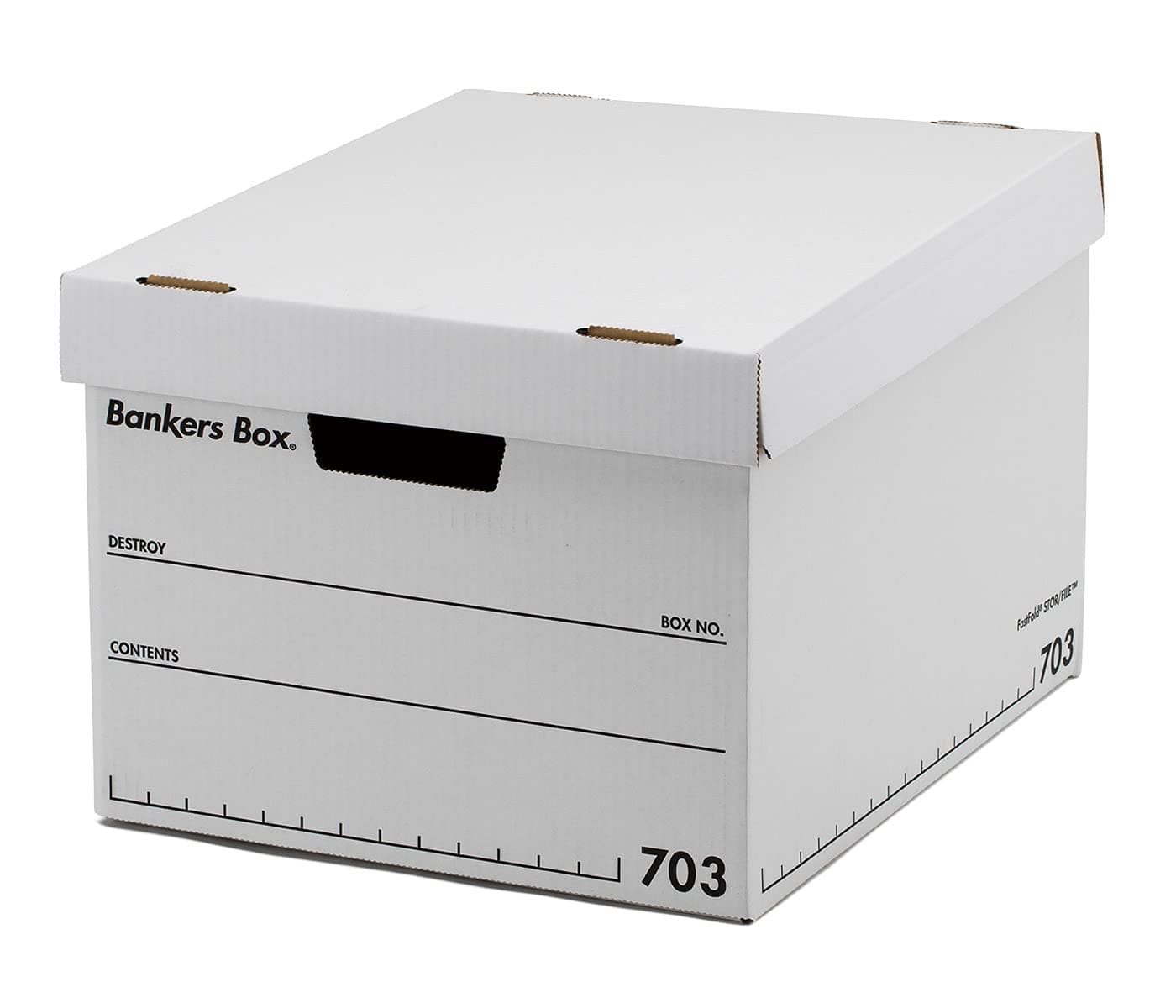
Has the "storage product itself" become a source of stress? The "Fellowes Bankers Box," beloved in American offices for over 100 years, is the king of paper-based storage that solves all these problems. You've surely seen those white boxes lined up across an entire wall in office scenes from movies and TV dramas. That's this box.
| "Sturdiness" that won't crush even when stuffed with bank documents

image Amazon
Don't dismiss it as "just a cardboard box, right?" Born in 1917 as a storage box for bank documents, this box was designed from the ground up to be packed full of incredibly heavy stacks of paper and stacked many tiers high.
Load capacity is roughly 30kg to 65kg (depending on the model). Even stacked five high, the bottom box won't buckle. The sides and bottom are cleverly designed with double and triple layered construction, boasting strength enough that even an adult sitting on it won't break it. It's on a completely different structural level from the typical moving cardboard boxes used in Japan.
| Assembles in 3 seconds, folds flat in 1
image Yahoo!
Another invention of the Bankers Box is the assembly structure called "FastFold." No packing tape required at all. Simply unfold the flat-packed box and push in the bottom — the base automatically locks into place. It takes just 3 seconds.
Conversely, when you no longer need it, just push the bottom up and it instantly returns to a flat panel. Plastic cases take up space even when unused, but a Bankers Box can be tucked away in any gap. This very mobility is the reason it's beloved by minimalists and people who relocate frequently for work.
| "Just lining them up" turns them into interior decor
image maika
I especially recommend this box to people who aren't good at tidying up. Clothes, magazines, kids' toys, sentimental items, empty gadget boxes. All those miscellaneous things you can't decide how to categorize — just toss them into this box and put on the lid. Then stack them in the corner of the room.
That alone makes the room look "tidied up." The simple design of a black logo on a white base looks great no matter how casually you stack them. In fact, the more boxes you accumulate, the more you line them up against an entire wall, the more the space takes on the air not of a storeroom, but of a "refined archive (library)." Whatever the contents may be, unifying the exterior completely erases the visual noise.
| When it's time to throw out, just put it out as recycling
image Amazon
Reducing plastic products is one of the challenges of our era. Because the Bankers Box is made of paper, when it gets old or dirty you can put it out as recyclable waste, just like ordinary cardboard. It's eco-friendly, with no guilt over disposal.
Also, the size that fits A4 files perfectly (the 703 series) pairs well with the depth of Japanese closets and built-in storage spaces, letting you make effective use of dead space.
| Conclusion: The final answer for display-style storage

image Free Design
A 3-pack runs around 2,000 to 3,000 yen. At under 1,000 yen each, it dramatically transforms the look of your room.
"For now, just put it in the Bankers Box." Simply by establishing that one rule, all the things scattered across your floor finally get an address of their own. There's a reason this design hasn't changed in 100 years. Throwing out the plastic cases and switching to paper boxes — it's the easiest way to update your room from "a place that feels lived-in" into "a creative space."