Written by: Jin Fujisaki / Published: 2026-02-11
There are countless denim brands in the world. But did you know that all of them are imitating a single "origin"?
In 1873, on the West Coast of America, Levi Strauss and Jacob Davis obtained a patent for pants reinforced with rivets (metal studs) to solve the problem miners had with pockets that quickly tore. This was the birth of the "Levi's 501" and the very beginning of denim history. More than 150 years later, the lot number "501" continues to be produced unchanged. This is not merely clothing—it is the most perfected piece of practical apparel that humanity has ever invented.
| Why "Button Fly"? Proof of Unbreakable Trust

image ZOZOTOWN
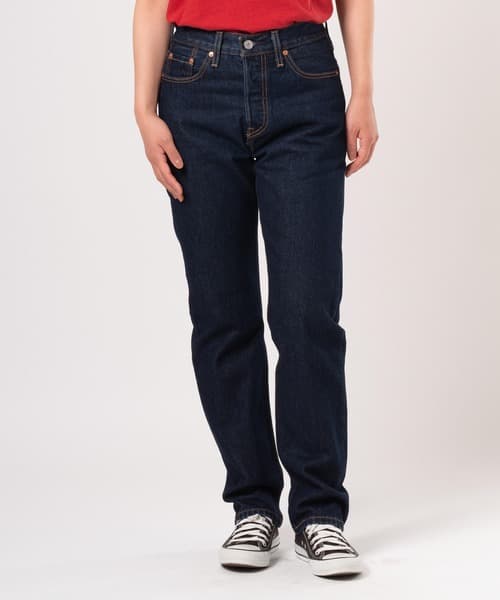
The greatest defining feature of the 501—and the first hurdle for newcomers—is that the front is fastened with buttons rather than a zipper, the so-called "button fly." "It must be a hassle when going to the bathroom." Everyone thinks so.
But this is the ultimate design for being "unbreakable." Zippers can jam or break, but buttons almost never do. And once you get used to it, the act of unfastening each button one by one, and the satisfying snap of fastening them back up, becomes a strangely pleasant ritual. This analog construction is precisely why it has survived for 150 years.
| The Ritual of "Wash and Shrink." A Shape That Becomes Yours Alone
image Jalana
The 501 carries the concept of "Shrink to Fit." In particular, the model known as "Rigid" (unwashed) is designed to shrink considerably when washed, conforming to the body of its owner.
At first, it may feel stiff, rough, and a bit too large. But you wear it, wash it, and wear it again. Through that repetition, the denim fabric memorizes the position of your knees, the thickness of your thighs, and the shape of your hips, settling into your body as if it were custom-made. Rather than "fitting your body to the jeans," "the jeans come to fit your body." Once you experience this sense of nurturing your own pair, the comfort of stretch-fabric jeans starts to feel bland.
| The Golden Ratio of "Straight," Untouched by Trends

image Men's Non-no
Skinny jeans are in, then wide-leg pants are in. Fashion trends change at a dizzying pace. But the silhouette of the 501 is "regular straight." Neither too wide nor too slim, it embodies an aesthetic of "the golden mean"—suiting any body type and any era of dress.
It looks great with just a T-shirt, and dressy when paired with a jacket. The reason Steve Jobs wore nothing but 501s in his later years was surely because he no longer wanted to agonize over "what to wear." The ultimate in ordinary—and that is exactly why it is the strongest standard of all.
| Spoken from Behind: The "Red Tab" and the "Arcuate Stitch"
image sixpacjoe
The icons of Levi's are the small "Red Tab" attached to the side of the right back pocket and the bow-shaped "Arcuate Stitch" sewn onto the pockets. They are marks of quality assurance and, at the same time, icons that let anyone recognize "Ah, that's a Levi's" from the back alone.
As you wear them in, the outline of your wallet whitens against the pocket (called "atari"), the stitching frays, and the red tab curls. Each of these signs of aging becomes a record of the time you've walked through. A pair of worn-out 501s is more valuable than a brand-new one. No garment other than denim is like this.
| Conclusion: A Piece of History You Can Wear for a Lifetime, for ¥10,000

image Levi's
Current models are priced at around ¥15,000 (and sometimes much less on sale). On the vintage market, certain pairs can trade for tens of millions of yen, but the greatest luxury is to take a current pair and raise it into a vintage of your own.
The button fly is inconvenient. The fabric is stiff. The color fades. But that very inconvenience is the true source of attachment. As our 100th article, no item could be more fitting. Why not, starting today, wear a piece of history called the 501?