Written by: Jin Fujisaki / Published: 2026-02-24
When fixing a mistake in a math calculation or rewriting a long passage, stubborn black pencil marks (erasure residue) that remain even after rubbing hard with an eraser, leaving your notebook looking messy — this is a major source of stress for students. And surely everyone has had the experience of rubbing too aggressively in an attempt to remove those marks, only to wrinkle the paper or, worst case, tear right through it.
Kokuyo's "Cleanly Erasable, Smooth-Writing Loose-Leaf Paper" tackles this dilemma faced by mechanical pencil and pencil users — the act of "erasing" — by rethinking the very structure of the paper itself. Born from real user feedback about being "bothered by erasure marks," it's a truly groundbreaking paper that scratches an itch you didn't even know you had.
| The Secret Lies in an Original Base Paper That Minimizes "Surface Texture"

image Kokuyo
So why can you erase so cleanly without applying any pressure? The secret lies in the smoothness of the paper surface, developed in-house by Kokuyo.
When viewed at a microscopic level, ordinary paper has fine fiber "bumps and grooves" on its surface, and graphite (lead powder) from a pencil works its way into these crevices, making it hard to erase. This loose-leaf paper, however, uses pulp from broadleaf trees with short, fine fibers, and through a refined press process during manufacturing, the surface texture has been reduced to an absolute minimum. Because the marks don't penetrate deep into the fibers, a light sweep with an eraser is enough to lift the graphite cleanly away, restoring a pristine, brand-new white surface.
| True to Its Name, It Writes Astonishingly "Smoothly"
image Kokuyo
The benefits of a low-texture surface aren't limited to easy erasing. As the product name suggests, the "smoothness" of writing has also dramatically improved.
The fine tip of a mechanical pencil glides across the paper with minimal resistance from snagging on fibers, running effortlessly as if skating across ice. Even during long lecture transcriptions or exam study sessions, your wrist tires less easily, and your writing speed gets a nice boost. Furthermore, thanks to Kokuyo's meticulously crafted original base paper, highlighters and ballpoint pens are also resistant to bleeding and show-through — another excellent feature that makes it ideal for study notebooks.
| The Beloved "Dotted Rule Lines" Are Fully Covered, Too
image Kokuyo
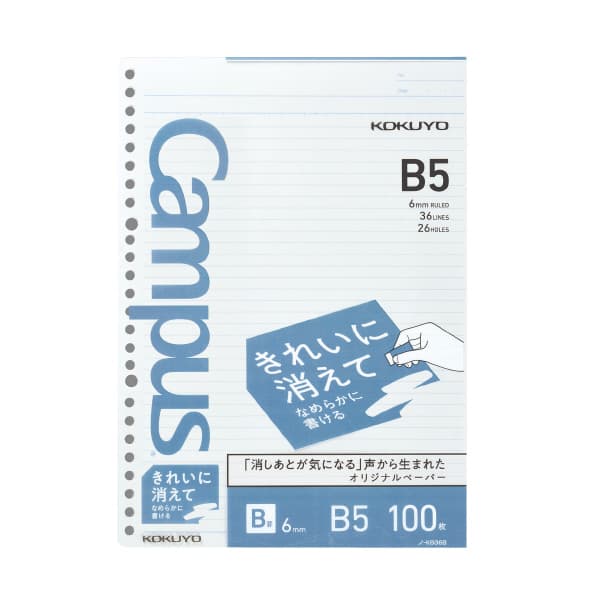
When it comes to Campus notebooks, the standard feature is the "dotted rule lines" with evenly spaced dots printed along the lines — and of course, this loose-leaf paper includes that lineup as well.
Whether you're drawing straight lines with a ruler, neatly aligning the start of each line, or accurately sketching figures and graphs, these dots provide overwhelming support. The size is the most standard B5 (26 holes), available in A-rule (7 mm width) and B-rule (6 mm width). Simply by swapping out the pages from your existing standard loose-leaf binder, you can elevate your study environment by a full notch without any sense of disruption.
| Summary: The Peace of Mind That You Can "Redo It" as Many Times as You Need
image Kokuyo
The price is 429 yen (tax included) for 100 sheets (manufacturer's suggested retail price). Compared to bargain-bin loose-leaf paper, it might feel slightly pricey, but the peace of mind of knowing you can "make mistakes as many times as you need and redo them cleanly without stress" delivers value that far exceeds the price.
Kokuyo's "Cleanly Erasable, Smooth-Writing Loose-Leaf Paper" is the "ultimate foundation" for students who learn through trial and error and for working adults who refine their ideas again and again. Experience this exquisite paper quality firsthand — it'll make you fall in love with the mechanical pencil in your pencil case all over again.