Written by: Jin Fujisaki / Published: 2026-02-14
Next time you open a cardboard box or cut wood for a DIY project, take a look at the utility knife in your hand. Notice the diagonal lines across the blade? When the tip gets dull, you snap it off and a fresh edge appears. This system is so commonplace today that we never think to question it — yet it was actually a groundbreaking invention born in a small Japanese factory in 1956.
Founder Yoshio Okada was inspired when he watched a glass-cutter craftsman score and break sheets of glass, and saw American occupation soldiers snapping off squares from bars of chocolate. "What if blades could be broken the same way? You'd always have a brand-new cutting edge." A blade that never needs sharpening and never loses its sharpness — that was the birth of the world's first snap-off blade utility knife.
| "OLFA" = "Oru-Ha" (Snap-off Blade). The Name Is the Function

image Yorozu News
The brand name "OLFA" comes from the Japanese phrase "oru-ha," meaning "snap-off blade." It's a fun fact that people all around the world call it "OLFA" without ever knowing the meaning behind the name.
The brilliance of this invention lies in its economy and efficiency. A single blade can be revived to like-new sharpness over and over again. No sharpening skills or time required. Just a quick snap with a pair of pliers or the included blade snapper, and you're done. This wonderfully simple system was a revolution that changed the history of stationery forever.
| Why Yellow? Standing Out in the Toolbox

image PR TIMES
When you think of an OLFA cutter, that distinctive yellow color comes to mind. There's a clear reason behind this choice of color, too.
Back when the cutter was being developed, tools were typically muted colors like black or silver. But sharp blades are dangerous tools. They had to be instantly recognizable as a cutter — even in dim worksites or buried inside a cluttered toolbox. The answer was "safety yellow" — a warm tone reminiscent of an egg yolk that also commands attention. Today, that yellow has become a symbol of functional beauty: see a yellow cutter, and OLFA is the first thing that comes to mind.
| More Than Just Paper. The Raw Power of the "L-Type"
image Yahoo!
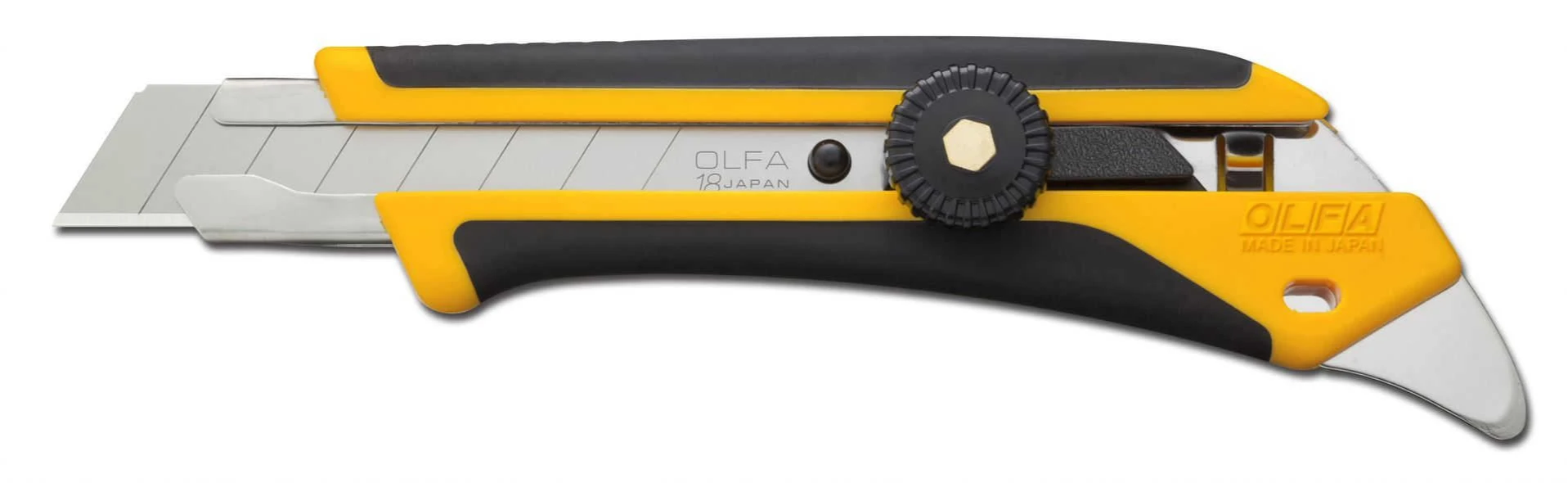
Today we're not looking at the slim cutter (S-type) found in most homes, but the chunky-bodied "Heavy-Duty L-type." This model uses the large-format blade favored by professionals on the job.
Its cutting power goes far beyond paper. Thick cardboard, of course — but also carpet, plywood, and even drywall — can be sliced through with surprising ease. The grip is thick and substantial, so you can apply real force without your hand cramping up. If you've ever thought, "a cutter is a cutter," try breaking down some cardboard boxes with this L-type just once. You'll be amazed by the way it slices through them like tofu.
| The 59-Degree Global Standard
image Orude Hardware Online Store
The blade angle on an OLFA cutter comes to a precise 59 degrees at the tip. This is the golden ratio — derived from pushing the balance between sharpness and durability to its absolute limit.
Even more remarkable: the blade dimensions and angle established by OLFA have become the global standard. That's why when you buy a utility knife made overseas, OLFA replacement blades will often fit it perfectly. One Japanese man's idea became the worldwide benchmark.
| In Summary: Japanese Pride You Can Buy for 500 Yen
image Chihara Hardware Store
The "Heavy-Duty L-type" runs about 500 to 600 yen. It's a tool you can pick up for the price of a single coin — but packed inside is the soul of Japanese craftsmanship.
Unpacking after a move, breaking down boxes from online shopping, kids' craft projects, DIY work. Just having one of these yellow cutters in the house can dramatically reduce the stress of every task. When it gets dull, just snap it off. Along with that satisfying little click, your work efficiency will improve dramatically too.