Written by: Jin Fujisaki / Published: 2026-02-13
When you're camping or having a BBQ and need to slice meat or open a package, what kind of knife do you reach for? A bulky survival knife or a box cutter would utterly ruin the atmosphere of a good meal. In French households, you'll almost always find this particular knife.
Created in 1890 by Joseph Opinel, a blacksmith from the Savoie region, "OPINEL" features a rounded wooden handle paired with a thin, sharp blade. It carries none of the intimidating presence of a weapon — instead, it feels warm, like a true "tool for daily living." Famously favored by Pablo Picasso for carving his sculptures, this knife is celebrated as one of the most beautifully designed industrial products in the world, and is even on display at London's Victoria & Albert Museum.
| Just 5 Parts. A Simplicity That Refuses to Break

image Amazon
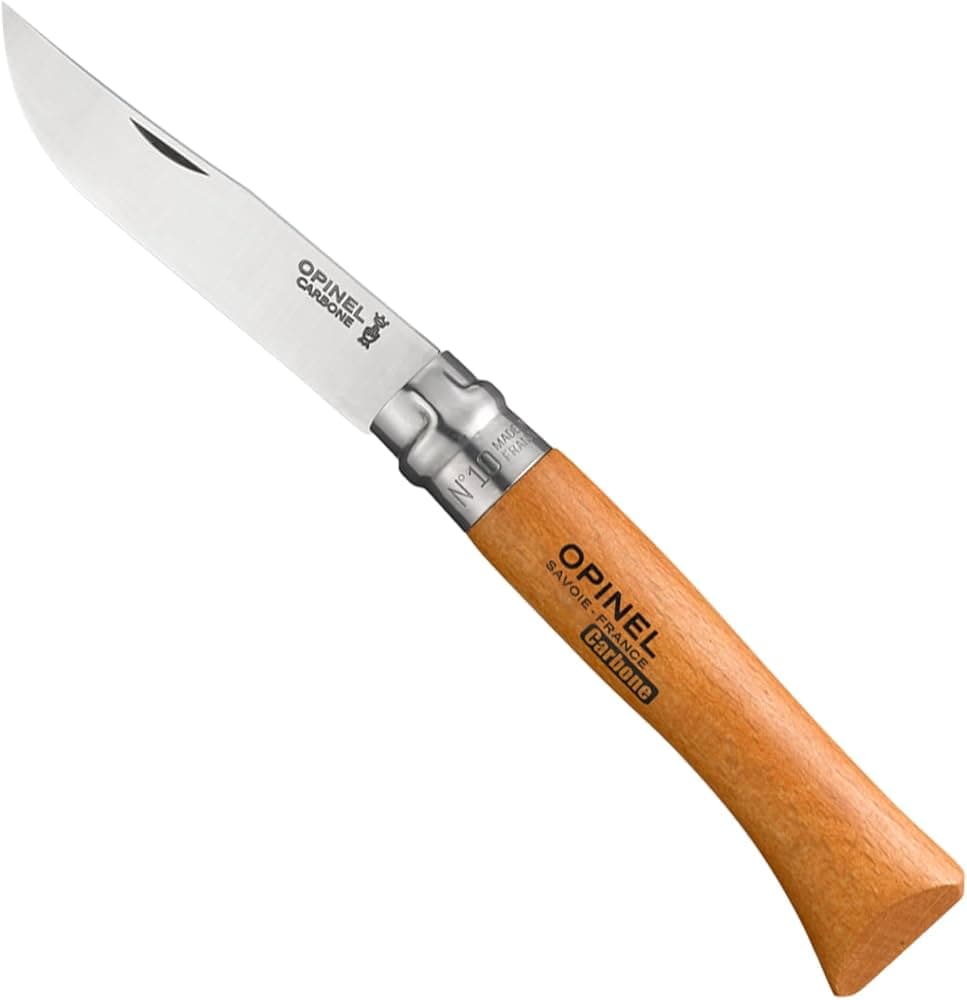
The construction of the Opinel is astonishingly simple. A blade, a handle, a fixing rivet, a bolster, and a locking ring. That's all there is to it.
With no springs or complex locking mechanisms, there's virtually nothing that can break. Even if it gets caked in mud, a quick wash and dry returns it to perfect condition. This straightforward, no-frills design is precisely why it has been loved for over a century without changing its form. The phrase "form follows function" might as well have been coined for the Opinel.
| Just Twist the Ring. The Safety Design of "Virobloc"
image Amazon
The scariest thing about a folding knife is the blade snapping shut on your fingers mid-use. The Opinel features a groundbreaking locking mechanism called "Virobloc," invented in 1955.
Simply give the metal ring at the base of the blade a quick twist. That's all it takes to lock the blade completely in place, making it absolutely impossible to close. You can also engage the lock when the blade is folded away, so there's no worry about it springing open in your pocket. It's intuitive enough for a child to handle, yet remarkably safe.
| Beginners Should Go Straight for Stainless
image TASTE
Opinel knives come in two main types of steel. There's "Carbon" (carbon steel), which is razor-sharp but rusts quickly, and "Stainless" (Inox), which resists rust and is easy to maintain.
If you're buying one now, I'd recommend "Stainless" without hesitation. Carbon steel will turn black just from slicing a tomato, and if left wet overnight, it'll be covered in red rust by morning. Stainless, on the other hand, holds up against fruit acids and moisture — just wash, wipe, and you're done. Especially if you plan to use it at the dinner table, stainless is the best choice since it has minimal metallic odor. If the handle is engraved with "INOX," that's your proof it's the stainless version.
| Size "No.8" Is the Global Standard — and Fits Japanese Hands Too

image OPINEL
Opinel knives come in sizes ranging from No.2 to No.12, but the one that fits the average male hand best is "No.8." With a blade length of about 8.5 cm, it's just right for peeling an apple, slicing a baguette, or carving up a steak.
For women or those with smaller hands, the slightly smaller "No.7" is also popular. The handle, made of beechwood, gradually absorbs the natural oils from your hand the more you use it, deepening into a rich amber color. Cultivating a handle that's uniquely yours is one of the joys of owning this knife.
| Summary: A Bit of French Wisdom That Enriches the Dinner Table
image Heimount
The "No.8 Stainless" runs about 2,000 to 2,800 yen. It's astonishingly affordable, but its cutting performance and usability are the real deal.
On a camp morning, slicing freshly baked bread and cheese with your Opinel — that alone is enough to make you feel like you've been transported to the French countryside. It transforms the act of "cutting" from a chore into a pleasure. The Opinel is a knife with that kind of magic.