Written by: Jin Fujisaki / Published: 2026-02-11
Have you ever washed a brand-new sweatshirt only to find that the body has shrunk so much that your stomach shows when you raise your arms? Standard sweatshirt fabric is knitted vertically, so it inevitably shrinks lengthwise in the wash.
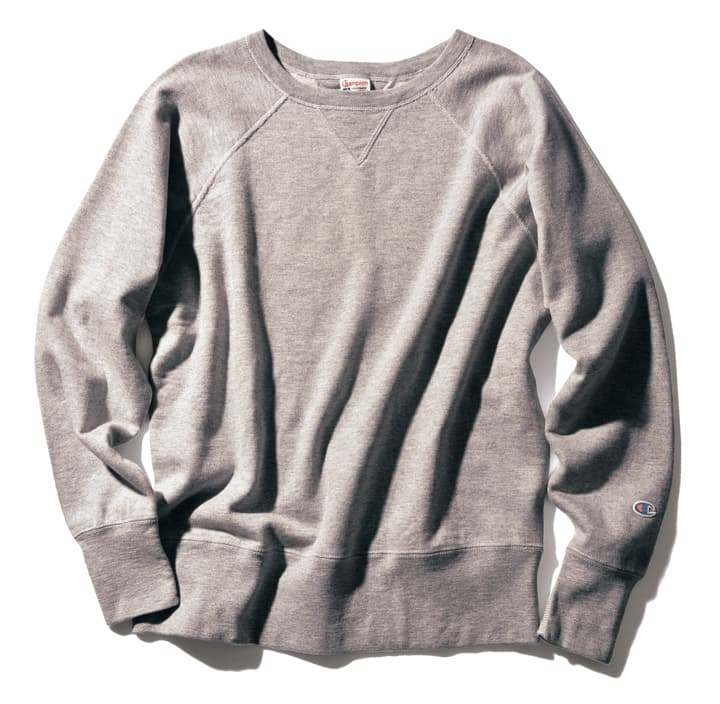
"Shrinking is just the way it is." That conventional wisdom was overturned by the "Reverse Weave," developed in 1934 by the American company Champion. As the name suggests — "Reverse" the "Weave." It's an invention that succeeded in preventing shrinkage simply by changing the direction of the fabric from vertical to horizontal.
| Using the fabric "sideways." A Columbus's egg of an idea

image FERANTRACING
The defining feature of the Reverse Weave is that fabric normally used vertically is deliberately oriented horizontally. This dramatically reduces vertical shrinkage.
At a glance it seems like a simple idea, but for the apparel industry of that era it was revolutionary. The body length doesn't change no matter how many times you wash it. It doesn't lose its shape no matter how many times it's laundered. This durability earned it a devoted following among college athletes across America, eventually winning Reverse Weave the title of "King of Sweats."
| The "ribs" under the arms are the secret to freedom of movement
image Cheep Shop
Using the fabric horizontally prevented vertical shrinkage, but it created a new problem: "horizontal shrinkage." Champion's solution was a ribbed material called the "expansion gusset," sewn into both sides.
These ribs prevent shrinkage in the horizontal direction while simultaneously providing stretch. Whether you raise your arms or move vigorously, the side ribs expand and contract so you never feel restricted. Easy to move in, and shrink-resistant. The ideal form for sportswear was completed right here.
| Toughness even the U.S. military endorsed. A 12.5-ounce suit of armor
image RAWDRIP
Among Reverse Weaves, the American-made model known as the "Red Tag" (MADE IN USA) uses an exceptionally heavy 12.5-ounce fabric. It has such substantial heft that ordinary sweatshirts feel flimsy by comparison. It protects your body almost like a suit of armor.
Its toughness was so renowned that it was even adopted as training wear by U.S. military academies. Durability built to withstand grueling training may be overspec for modern daily wear. But it's that "excessive strength" that stirs something in a man's heart.
| The charm of "vintage" — the more worn out, the cooler it looks

image SPERM ONLINE STORE
A brand-new Reverse Weave has tightly woven, stiff fabric and a fluffy brushed lining. But the true appeal lies beyond that.
As you wash it again and again and wear it hard, the fabric softens and conforms to your body, and the color fades. Even when the collar and cuffs start to fray a bit, it just becomes part of the "character." Decades-old Reverse Weaves trading at high prices in vintage shops are proof of this. The brand-new one you buy today will be a complete vintage piece ten years from now.
| In summary: A lifetime sweatshirt for around 10,000 yen
image POST78
The price for the current standard model (such as the Blue Tag) runs from about ¥10,000 to ¥12,000. The premium American-made version (Red Tag) is around ¥18,000. It's pricier than a Uniqlo sweatshirt, but if you consider that you can "wear it for 10 years" and that "it won't lose its shape," the cost performance is unbeatable.
"As long as you're wearing this, you can't go wrong." Clothes that give you that kind of confidence are rare. A timeless standard that never falls in or out of fashion. This fall and winter, why not spend the season wrapped in a piece of history called the Reverse Weave?