Written by: Jin Fujisaki / Published: 2026-01-29
Clear files overflow in offices and homes everywhere. They're convenient for tucking papers away on the fly, but aren't they actually full of flaws?
Slip in a few sheets and they slide right out; cram in too many and the mouth gapes open, sending the contents bursting out. More fundamentally, the fact that they hog the same shelf space whether they hold 1 sheet or 100 is just plain "inefficient."
"SAND IT," developed by TENT and KING JIM, is a tool dedicated—as its name suggests—to "sandwiching." This is less a piece of stationery and more a "compression folder" that optimizes analog paper information.
- | A "Board" Held Together by a Single Rubber Band
- | Why This Shape?
- | A Place Where "Just-for-Now" Is Allowed
- | Who Is It For?
- | In Summary | ZIP Your Analog Data
- | Related Information
| A "Board" Held Together by a Single Rubber Band

image TENT
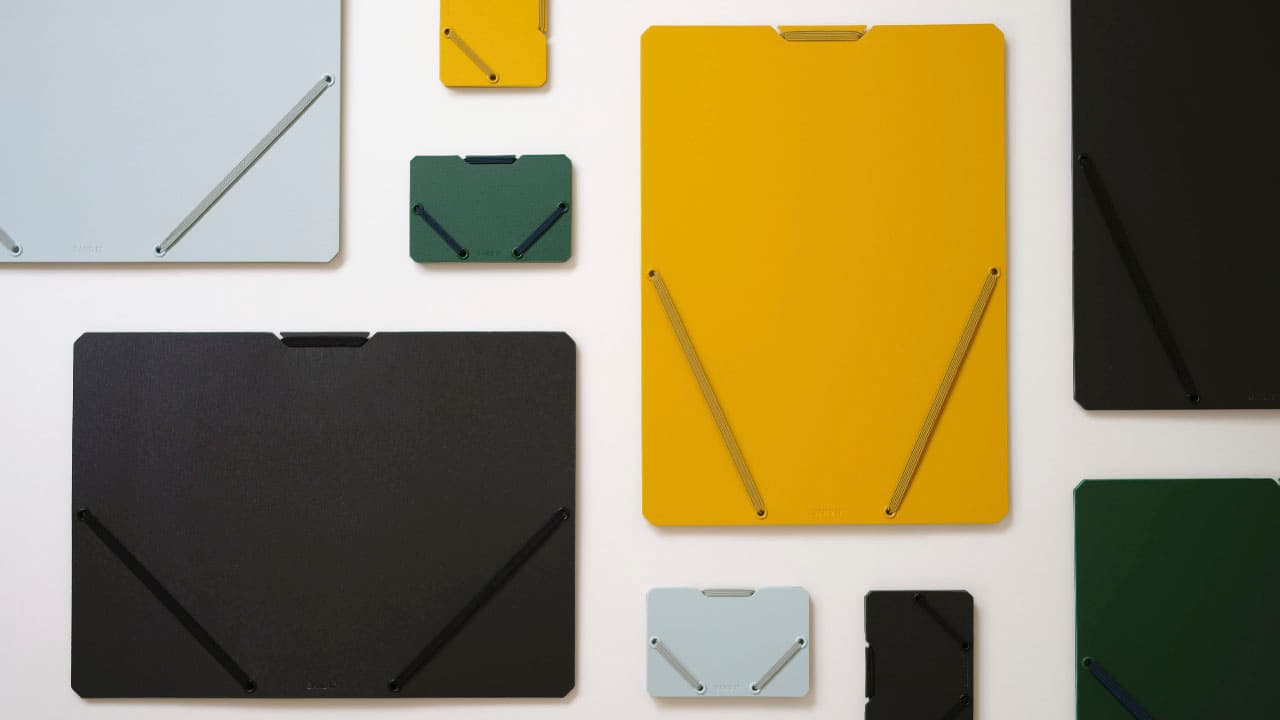
The construction of SAND IT is extremely simple. A resin sheet with just the right amount of stiffness, and a flat rubber band to hold it shut. That's all.
And yet this construction is revolutionary. By harnessing the elasticity of the rubber band, whether the contents are a single flimsy sheet of paper or a hefty stack over 1 cm thick, it always self-adjusts to the "optimal thickness."
There's no zipper to open and close, no button to fasten. Just snap the rubber band into place. In that half-second action, papers that would otherwise scatter are powerfully compressed into a single, beautiful "board."
| Why This Shape?
image TENT
A "rubber band closure" can easily come across as cheap, but here there's sophisticated design and material selection at work.
- Foamed PP sheet construction: The cover uses a lightweight, durable three-layer foamed PP (polypropylene). It avoids the cheap feel of plastic, with a matte, premium texture in the hand. This rigidity also protects the documents inside from getting bent or creased.
- Two index dividers: The interior is split into three compartments by two divider sheets. Just toss things in to sort them as "unprocessed," "in progress," or "archived"—task management is done in one motion.
- Built to be tossed in a bag: The horizontal (landscape) design acts as a "lid" inside your bag, preventing documents from slipping out. The vertical (portrait) version is ideal for accessing documents while keeping it stowed in your backpack.
| A Place Where "Just-for-Now" Is Allowed
image TENT
The greatest appeal of SAND IT is its generous tolerance for sloppiness.
Receipts, direct mail, contracts, your kid's printouts from school. Whatever the size or type, you just toss the paper into SAND IT without thinking and snap on the rubber band. And somehow, mysteriously, you get that "tidied up" feeling.
Because the tension of the rubber band squeezes the contents firmly, the edges of the papers align, and they look like a neat, orderly stack. The worse you are at staying organized, the more you'll be saved by this "physical forced-alignment function."
| Who Is It For?
image TENT
In this paperless age, this product is recommended for everyone still battling with "paper."
- Nomad workers: Anyone who wants to carry a small stack of documents alongside their laptop in style (the A4 model also doubles as a 13-inch laptop sleeve).
- Freelancers before tax season: Anyone who wants to gather and compress a year's worth of receipts in one place for the time being.
- Students and researchers: Anyone who wants to sort materials by class or project and manage them with color coding.
| In Summary | ZIP Your Analog Data
image TENT
So, what do you think?
SAND IT isn't a case for storing documents. It's a tool that compresses scattered information—using the power of a rubber band—into something like a "ZIP file" that you can carry around.
Slim, yet high-capacity. Simple, yet highly functional. This invention, which costs less than a 500-yen coin (*depending on the size), just might be the decisive blow that clears the "mountain of paper" off your desk.