Written by: Jin Fujisaki / Published: 2026-02-12
Walk into any home center and you'll find piles of blue and red plastic cooler boxes. They're cheap, light, and convenient. But the moment you set one down at a campsite, there's no denying that a certain "cheapness" hangs in the air.
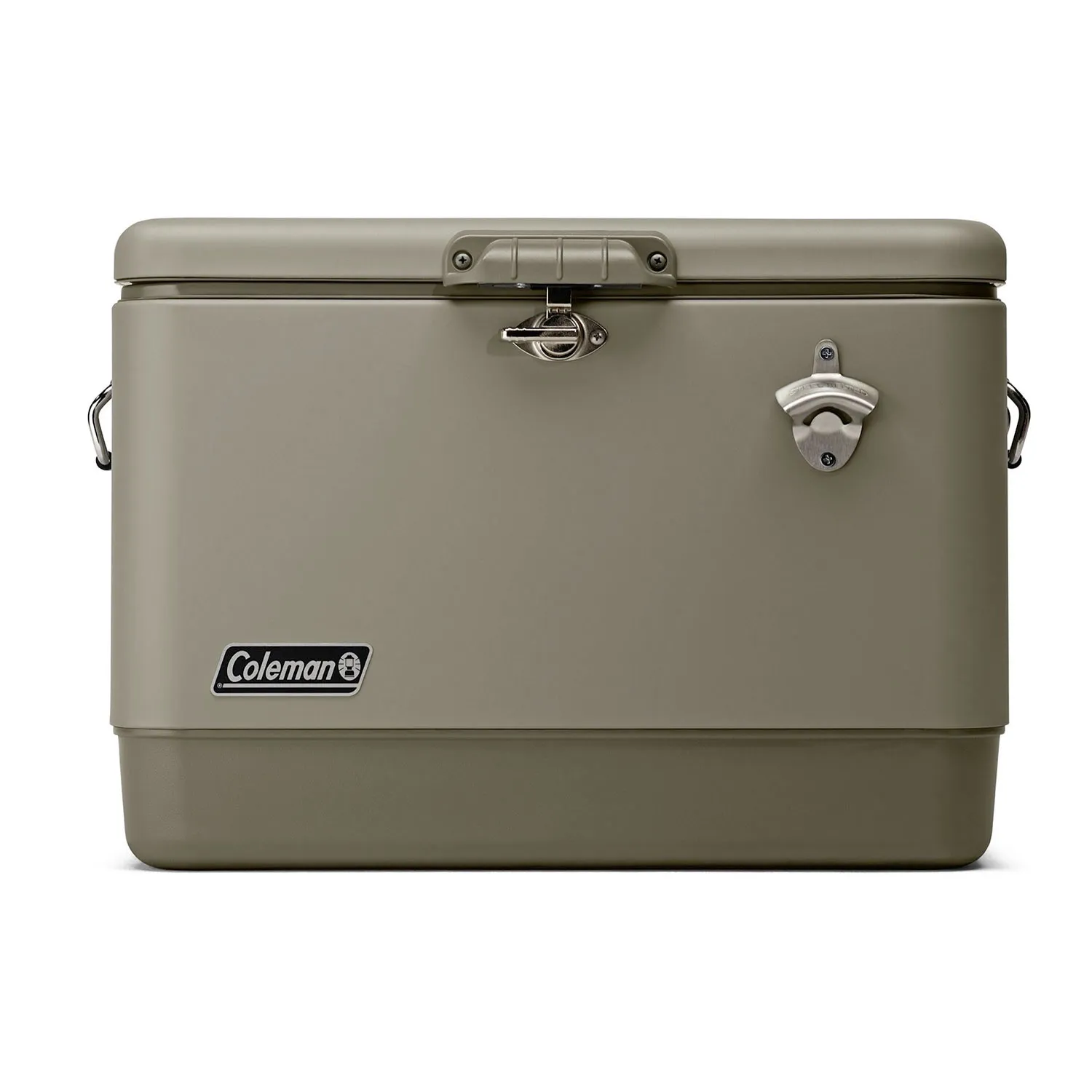
In 1954, as a symbol of America's prosperous era, Coleman introduced the "Steel Belt Cooler." Its design was modeled directly after the refrigerators found in American homes at the time. The gleam of stainless steel, the rugged latches, and an overwhelming sense of presence. More than 60 years after its release, the design has barely changed. This isn't just an insulated box—it's a piece of furniture that transforms the atmosphere of your site simply by being placed there.
| Plastic Cracks, but Steel "Dents"

image Coleman
Plastic cooler boxes "crack" when dropped or knocked around. Once they crack, it's over. The Steel Belt Cooler is different. Because it's made of metal, an impact leaves a "dent" instead.
These dents are the very essence of the Steel Belt's appeal. A Steel Belt that has been used for years—scratched up and dented here and there—looks far cooler than a brand-new one. Each mark is a memory of a journey, the very history of the camping trips you've taken. "You don't have to be afraid of damage." That toughness liberates you from the stresses of the outdoors.
| Ice That Lasts a Two-Night Trip: A 3 cm-Thick Insulated Wall
image BEST ITEM
It's not all about looks. The generous "54QT (approximately 51 liters)" body is packed with roughly 3 cm of foamed urethane insulation. This delivers astonishing cooling performance, even under the blazing midsummer sun.
Pack it well with ice and it's not unusual to find ice still remaining on the morning of day three of a two-night camping trip. The interior height is also perfectly judged to fit 2-liter PET bottles upright, letting you stuff it full of food and drinks. When it comes to the basic job of "keeping things cold," it holds its own against even today's high-tech coolers.
| The Satisfying "Clack" of the Cam Latch
image Minna no Ichiba
One of the joys of using a Steel Belt is opening and closing the lid. Most affordable cooler boxes seal the lid by pressing it down and relying on friction, but this one uses a metal locking mechanism called a "cam latch."
You close the lid, hook the latch, and push the lever down. With a metallic "clack!", you feel the cooler seal shut. This ritual-like operation gives you the reassurance that your food is being protected. The sensation is so addictive you'll find yourself wanting to open and close it for no reason at all.
| A Canvas to Color With Stickers, Your Way

image Machikado Ichiba
The sides of the Steel Belt are wide, flat metal surfaces. For campers, they make the perfect canvas.
Stickers from the campgrounds you've visited, logos of your favorite outdoor brands, decals you picked up on your travels—stick them on freely and you'll create a one-of-a-kind original cooler. The more you add, the more attached you become, until it's "my refrigerator," unlike anyone else's. That room for customization is another reason it's loved for the long haul.
| Summary: A "Lifetime Box" Worth Every Bit of 30,000 Yen
image Nodoma Camp
Current models run somewhere between 30,000 and 40,000 yen. That's several times the price of a plastic cooler, but considering you'll never need to replace it, it's hardly expensive.
Keep it at home and it doubles as a stylish storage box or a drink cooler for house parties. Above all, the rush you feel the moment you load it into your car is something no other piece of gear can match. Why not pack this silver box with beer and head out on your next camping trip?