Written by: Jin Fujisaki / Published: 2026-02-13
Walk into any home center and you'll find shelves lined with cheap, lightweight plastic storage cases. But once you set one down in your living room or at a campsite, doesn't it always give off a certain "cheapness"? And after a few years, UV light degrades it, the handle snaps, and it ends up in the trash.
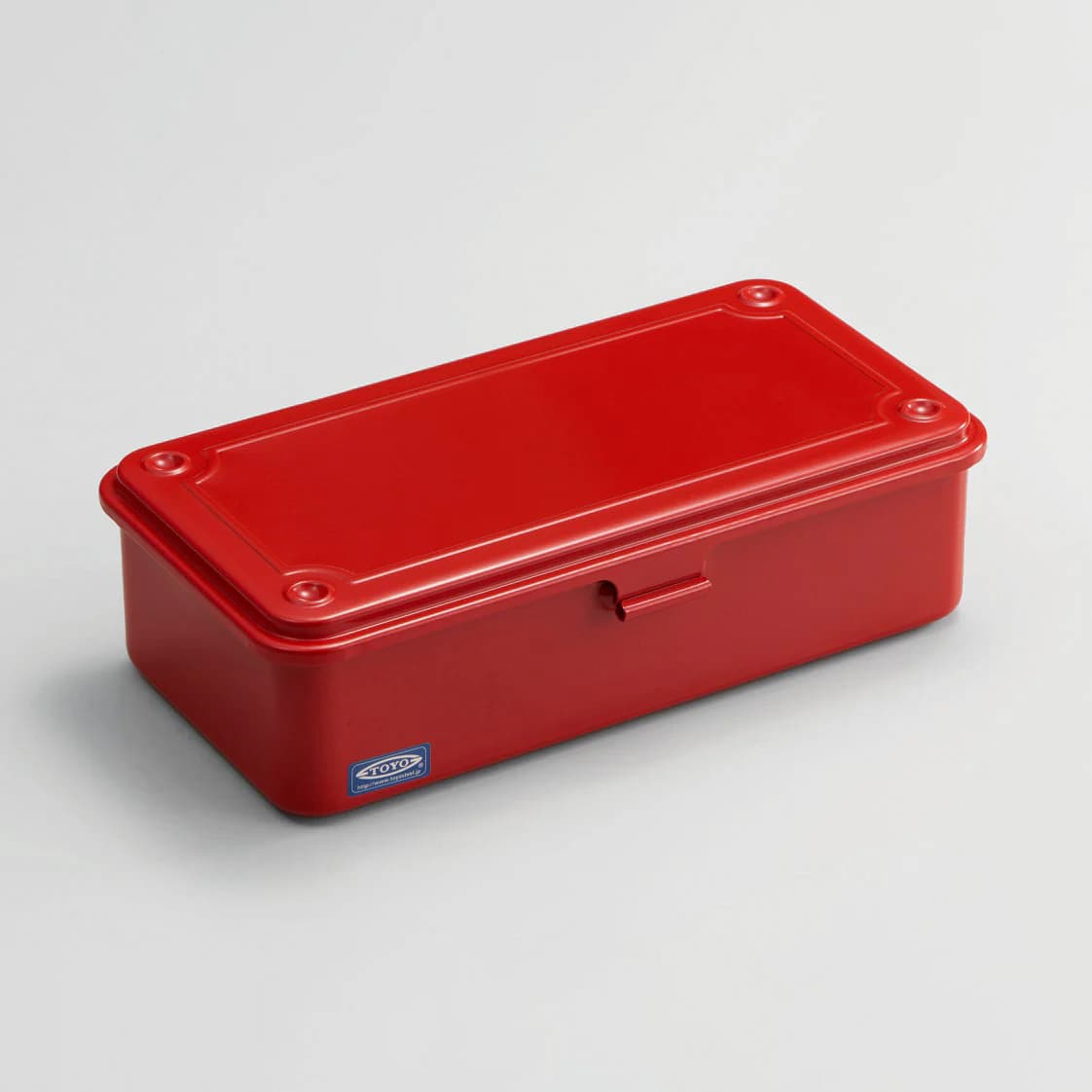
Standing on the complete opposite end of that "disposable" storage spectrum is the toolbox made by Toyo Steel, a company born in Osaka in 1969. They were the first in the world to successfully press a single sheet of steel into a "seamless" toolbox. Their craftsmanship and design have captivated not only Japanese tradesmen but creators around the world — so much so that their products are stocked in the shop of the Museum of Modern Art (MoMA) in New York.
| No Welds, No Seams. The Magic of "Deep Drawing"

image Toyo Steel Co., Ltd.
Toyo Steel's defining feature is a press-forming technique called "deep drawing" (fukashibori). Normally, making a metal box involves cutting a sheet, folding it, and welding the corners together. But Toyo Steel's boxes are formed by pressing a single sheet of steel with an enormous press machine, squeezing it into shape.
As a result, you won't find a "seam" anywhere on the box. The corners are rounded (R-finished), smooth, and gentle to the touch. No seams means no rust creeping in, no leaks, and no edges to catch on. Pour oil inside and it won't leak; spill liquid detergent and you can simply wipe it away. It looks simple, but it's actually a remarkable feat of engineering.
| Won't Break Even If You Step on It. Even Dents Become "Character"
image Traveler's Notebook
Plastic cracks, but steel doesn't. Drop a Toyo Steel box by accident, run it over with a car — it won't break easily. And if it does get dented? Just tap it back into shape with a hammer.
In fact, you could argue that the box reaches its true form only after years of use, with paint worn away and dents and scratches earned along the way. Like the fading of denim or the creases in leather shoes, you get to enjoy the aging (patina) of metal. It looks cooler ten years from now than it does brand new. That's the biggest reason to choose "steel."
| Why the "Mountain" Shape? There's a Reason Behind the Design
image Toyo Steel Co., Ltd.
The flagship model "Y-350" has a lid that rises into a "mountain" shape. This isn't just for looks. It's a clever design that lets the lid close even when the tools or items inside are slightly taller than the box.
It can't be stacked, but in exchange, fold down the handle and the lid sits flat — turning it into a handy little workbench. The satisfying metallic click of the buckle is a pleasure in itself, and its rugged yet somehow charming silhouette has barely changed since it first went on sale in 1969. It's no surprise it received the "Good Design Long Life Design Award" in 2009.
| More Than Just Tools. From Camping Gear to Sewing Kits

image Begin Market
It may be called a "toolbox," but limiting it to tools would be a waste. Its beautiful looks and sturdiness make it shine in all kinds of settings.
At the campsite, it's a container for pegs, hammers, and seasonings. In the living room, it works as a first aid kit for medicine and bandages. Or use it as a sewing box for thread and pin cushions, or an art box for your supplies. The wide range of colors (red, blue, silver, olive drab, and more) means it blends seamlessly into any interior. It will become the perfect "treasure chest" for whatever hobby you want to pack inside.
| In Summary: A Lifetime Storage Box for Around 3,000 Yen
image Yahoo!
The classic "Y-350" runs about 2,000 to 3,000 yen. It's pricier than a plastic case, but considering you'll never need to replace it, the cost performance is overwhelmingly better.
You might think, "Why spend money on a box?" But the moment you bring one home, you'll find yourself wanting to organize what goes inside, wanting to handle it with care. A sturdy, gentle steel box made by a small Japanese factory. Try setting just one down in the corner of your room.