Written by: Jin Fujisaki / Published: 2026-02-13
Try picking up one of those cheap sunglasses sold at convenience stores or variety shops. They're light and convenient, but the lenses are thin plastic (polycarbonate). Toss them in your pocket and they scratch instantly, leaving your view cloudy and white. And above all, when you put them on, they have an unmistakable air of cheap, toy-like flimsiness.
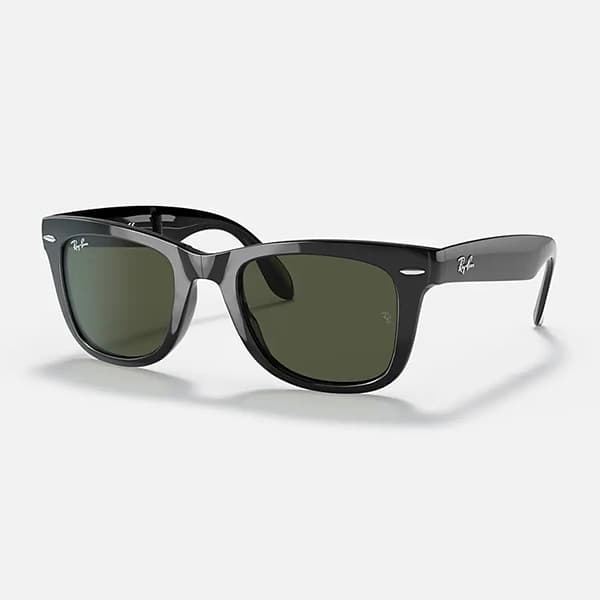
When you pick up Ray-Ban's "Wayfarer," born in 1952, you're struck by its substantial heft. That's because there's a metal core running through the frame, and more importantly, because the lenses are made of "tempered glass." This weight itself is proof of the real deal. It's an honest weight that lives up to the function of "protecting your eyes."
| A View That Won't Scratch: The Power of the "G-15" Lens

image Poker Face Online Store
The standard lens equipped on the Wayfarer is a dark green glass lens called "G-15." The "G" stands for Green, and the "15" indicates a visible light transmittance of 15%.
What makes this lens remarkable is its overwhelming "hardness" and "naturalness of vision." Because it's made of glass, it doesn't flinch at sand, dust, or minor friction. Unlike plastic lenses, your view never gets clouded by tiny scratches, and clear vision lasts virtually forever. Furthermore, the distinctive green—neither gray nor brown—is a technology originally developed for U.S. military pilots as the color that most naturally reproduces the tones of objects you see. The blue of the sky and the green of the trees alike can be seen in their true colors.
| Why Does It Look So Cool? The Secret Lies in the "Tilt"
image Minami Megane
There's a reason people who wear Wayfarers somehow look more chiseled and cooler. It's the frame's "forward tilt angle (pantoscopic tilt)."
When viewed from the side, you can see that the front section isn't perpendicular to the face but instead slants sharply inward. Originally, this was a functional design meant to block sunlight from above, but this angle adds dimension to the face and creates an unmatched bad-boy edge (a wild quality). Some people find the frame pressing against their cheeks, yet many fans still insist on this original (RB2140) tilt because this distinctive silhouette is one of a kind.
| The Sturdy Click of Opening and Closing, Supported by the "7-Barrel Hinge"
image Megane Flower Online Shop
When you fold the temples (arms), there's a crisp "snap" sound. What supports that motion is the extra-thick "7-barrel hinge."
While most eyewear typically uses 3 or 5-barrel hinges, the Wayfarer is built by interlocking seven metal plates. This keeps the frame from loosening even after years of use, maintaining smooth opening and closing. Rugged acetate frames paired with sturdy metal parts. These aren't a delicate accessory—they're "gear you wear on your face."
| A Symbol of Rock, Cinema, and the Rebel Spirit

image SALIPO
Bob Dylan wore them. The Blues Brothers wore them. Tom Cruise wore them in the film Risky Business. The Wayfarer transcends being a mere fashion item—it's 20th-century pop culture itself.
Behind it all has always been "freedom" and a "rebel spirit." Whether paired with a suit or a T-shirt, there's always a hint of rock-and-roll in the air, perhaps because the history this pair of sunglasses has walked through shines through them. In an eyewear industry where trends come and go violently, the fact that they've kept selling for over 70 years without changing shape speaks volumes about their perfection.
| In Summary: The "Confidence" You Can Buy for 20,000 Yen
image FREE SHIPPING
The price for the standard model runs around 20,000 to 25,000 yen. It's not exactly cheap, but considering the lifespan of glass lenses and the timeless design, it's a lifetime investment.
You don't just put them on because "the sun is strong today"—you put them on because "you want to feel confident." The Wayfarer has that kind of power. The world seen through these heavy glass lenses is sure to look just a little more vivid and dramatic than usual.