Written by: Jin Fujisaki / Published: 2026-02-22
"Rubbing beef tallow on your face." It sounds like a joke or a punishment if you only hear the words, but as of 2026, the skincare product winning the most fanatical support in overseas beauty communities and on TikTok is none other than this: "Whipped Tallow."
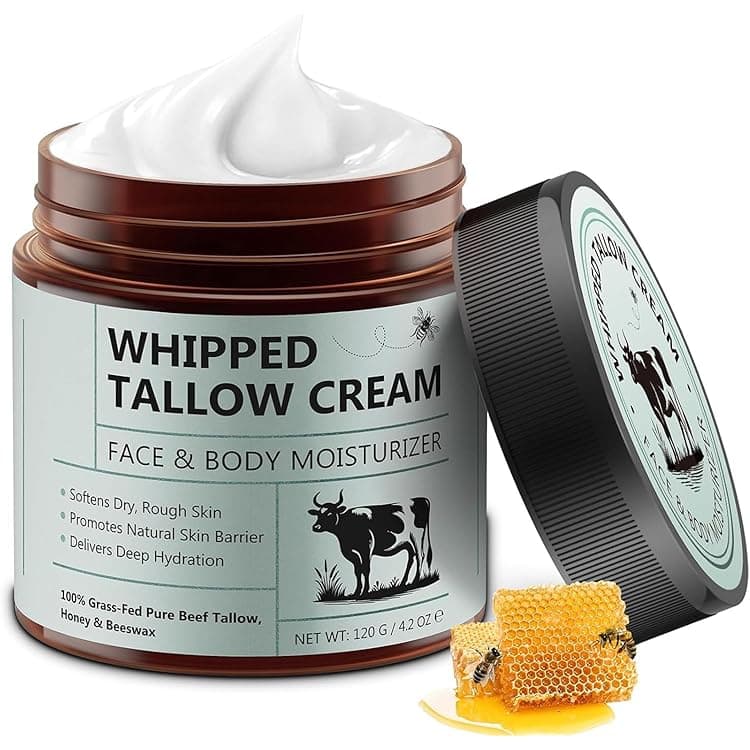
Stripped of every chemical ingredient, this almost primitive cream is nothing more than thoroughly rendered fat from grass-fed cattle, whipped into a fluffy texture. So why are people now throwing out the high-end department store cosmetics they paid a fortune for, switching instead to "cow fat"? The reason lies in the data and in biological compatibility.
| A "Bio-Identical" Fat — The Closest Match to Human Sebum

image Amazon
The single biggest reason tallow excels as skincare lies in its molecular structure. The fatty acid composition of beef tallow (the balance of oleic, palmitic, and stearic acids) is astonishingly similar to that of human sebum.
As a result, it absorbs into the skin far better than plant-based oils such as jojoba or coconut, sinking smoothly into the stratum corneum the moment it's applied. On top of that, it's rich in the animal-specific vitamins A, D, E, and K — nutrients almost absent from plants — which work directly on skin repair and the strengthening of the barrier function. It's an extremely rational approach: replenishing your skin with exactly the kind of fat it has been craving all along.
| The Texture: "The Finest Whipped Cream"
image Dutch Meadows Farm
If you shuddered imagining yourself smearing one of those blocks of beef tallow from the supermarket onto your face, rest assured. Skincare-grade whipped tallow goes through a careful "purifying" process, in which impurities are filtered out repeatedly and the fat is simmered in water.
That purified, snow-white fat is then chilled and whipped at high speed while air is incorporated, transforming it into a texture as fluffy as a premium whipped cream or soufflé. Scoop some onto your fingers and it melts instantly with body heat, leaving no heaviness or stickiness behind — instead it lays down a thin yet powerful protective film on the skin. It spreads so easily that an amount the size of a grain of rice is enough to cover the entire face, which makes it remarkably cost-effective too.
| What About the Smell? Won't It Smell Like Steak?
image Delightful Mom Food
When people hear "beef tallow," the very first concern is the smell. The short answer: properly purified, high-quality grass-fed tallow is virtually odorless (you might pick up only a faint, buttery richness).
Most of the whipped tallow sold on the market also blends in natural essential oils such as lavender, frankincense, or sandalwood. The result, in actual use, feels like nothing less than a luxury aromatic cream. There's no need to worry about your face smelling like steak or yakiniku and dogs chasing you down the street.
| The Ultimate Minimalism. One Jar Covers Your Entire Body

image Butter Hide Tallow Products
Another appeal of whipped tallow is its almost absurdly wide range of uses. It works as a facial moisturizer, of course, but also as a body cream for dry elbows and heels, a lip balm, a hair wax, and even as a diaper rash cream for babies. Since it's safe to ingest (it is, after all, just beef tallow), there's no harm if you happen to lick a bit off your fingers while cooking.
Preservatives, emulsifiers, artificial fragrances, parabens — "zero" of them. The ingredient list reads: "grass-fed beef tallow, olive oil, essential oils." That's it. The end. You can throw away the row of bottles lined up on your bathroom counter and consolidate everything into this one glass jar. For minimalists, it's the ultimate "beauty by subtraction."
| In Closing: The Luxury of Going "Back to Nature"
image
Pricing for organic brands runs roughly ¥3,000–¥5,000 per jar (about 60g). Before you sink tens of thousands of yen into expensive serums, why not try the power of "animal fat" — something humanity has long relied on as a wound balm and moisturizer? What your skin has truly been asking for may not be the latest cutting-edge chemical compound, but this primitive whipped cream.