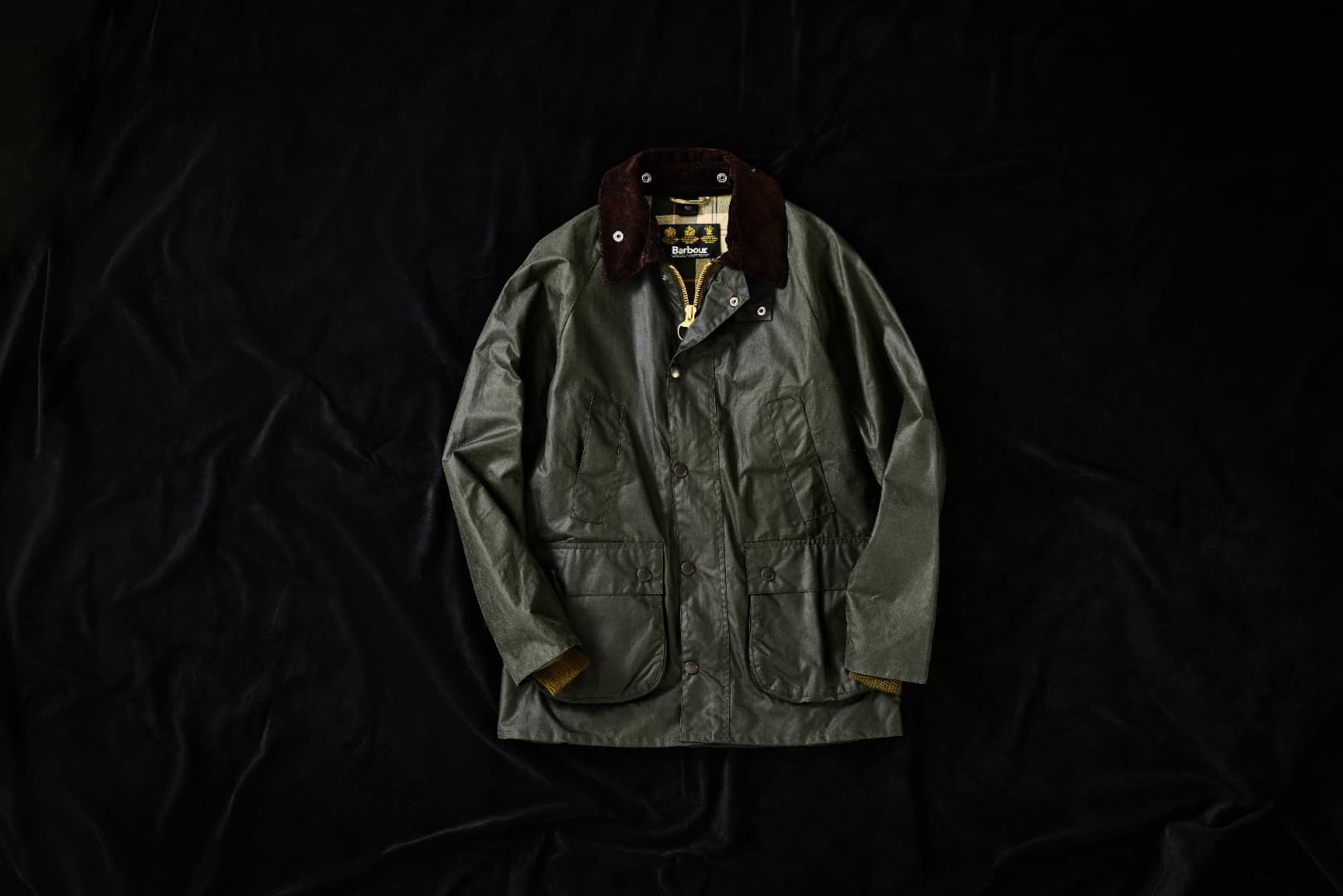
Written by: Jin Fujisaki / Published: 2026-02-11
What kind of outerwear do you reach for on a rainy day? Choosing lightweight, convenient nylon or high-performance Gore-Tex is the modern norm. But long before synthetic fibers were invented, the dockworkers and shepherds of Britain fended off the rain with something far more primitive—and far tougher.
That something was "waxed cotton"—cotton fabric impregnated with oil to make it waterproof. Founded in 1894, Barbour has continued to use this classic material, eventually earning the prestigious honor of a Royal Warrant. Heavy, sticky, and faintly pungent. So why has such an inconvenient jacket continued to be loved by gentlemen the world over?
| The Functional Beauty of the "Bedale," Born for Horseback Riding

image Borbour
Barbour has produced several masterpieces, but the most popular in Japan is the "Bedale," developed as a riding jacket. Every detail of its design has a purpose.
The hem is cut short so it doesn't get in the way when you're in the saddle. The back features slits called "side vents" that open and close with buttons to ensure freedom of movement. The cuffs are fitted with "ribs" that block the wind from creeping in, keeping your body heat sealed in even on stormy days. And if you slip your hands into the high-set "handwarmer pockets" on the chest, you can keep them warm without gloves. These aren't fashion details—they're functions for survival.
| It's Not That It "Can't Be Washed." It "Must Not Be Washed."
image Borbour
Barbour's greatest characteristic—and its greatest hurdle—is that it can't be washed. If you toss it into the washing machine with detergent, the oil that was painstakingly worked into the fabric for waterproofing will wash away, the fabric will shrink, and you'll be left with nothing but a grubby piece of cotton cloth.
When it gets dirty, simply wipe it gently with a damp sponge. And once every few years, you perform a ritual known as "re-proofing" to replenish the oil that has worn off. You melt the dedicated wax in a hot-water bath, work it into the fabric with a sponge, and blend it in with a hairdryer. Your hands will be coated in grease, but it's precisely this process that gives you the powerful, tangible sense of "raising" your jacket.
| Brand-New Is Embarrassing. The Aesthetic of Chalk Marks
image Borbour
A freshly purchased Barbour is heavy with oil, glossy, and frankly a little embarrassing to wear. But as you wear it in, the oil settles, friction-prone areas fade in color, and white lines called "chalk marks" appear along the creases.
This is the "character" of a Barbour. A Barbour worn for ten years until it's soft and worn-out is overwhelmingly cooler than a brand-new one. In Britain, there's even a joke that wearing a brand-new Barbour will get you laughed at as "still a greenhorn." A jacket whose creases have been carved to fit your own body is truly a second skin.
| The Only Outdoor Jacket You Can Throw On Over a Suit
image Borbour
Originally a piece of workwear, the Barbour pairs surprisingly well with a suit. In fact, well-dressed Italians deliberately delight in throwing a rugged, earthy Barbour over a fine suit.
The fusion of "dress" and "work." This gap is precisely what exudes the easy confidence of a grown man. Of course, it works just as well with jeans and a T-shirt. Weekdays or weekends, rainy days or sunny ones. Slip on the one hanging by your front door, and you have a companion that will go with you anywhere.
| Conclusion: A Grown-Up Luxury in Loving the Inconvenience
image Borbour
The price runs around 50,000 to 60,000 yen. It's not cheap, but with proper care, it will last a lifetime. "I'm worried the oil will rub off on the other clothes in my closet." "Won't I be a nuisance to people on a packed train?" For those with such concerns, non-oil (un-waxed) models are also available.
But let me say this anyway. Loving even the inconvenience is what the Barbour culture is all about. The more trouble a child gives you, the more dearly you love them. This jacket is sure to teach you the meaning of "cherishing your belongings."