Written by: Jin Fujisaki / Published: 2026-02-13
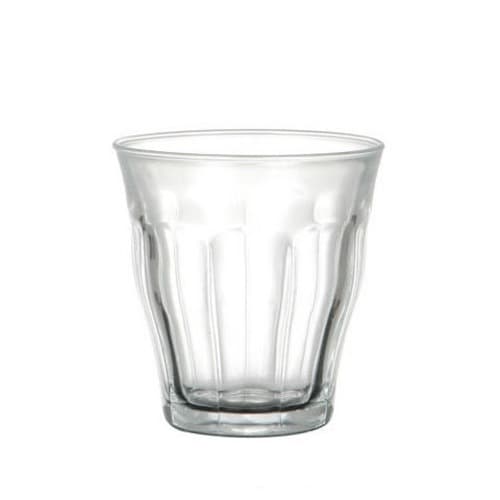
When you walk into a stylish café and they bring you a glass of water, or when you order wine at a Parisian bistro—the glass in your hand is, more often than not, this very one. A slightly thick glass tumbler with crisply faceted sides.
It's the "Picardie" by "Duralex," born in France in 1954. Why do restaurants and cafés all over the world use this one in particular? Because the design is good? Because it's cheap? The biggest reason is far more practical. It's because "they simply don't break."
| The Magic of "Fully Tempered Glass"

image Hands
The Picardie is no ordinary glass. During production, the glass is heated to around 700°C and then rapidly cooled to strengthen it—what's known as "fully tempered glass." Its strength is said to be about 2.5 times that of regular glass.
Even if you accidentally knock one off the table onto a hardwood floor, there's a good chance it will let out a cheerful "klonk!" and bounce right back up—almost like a rubber ball. It overpowers the common assumption that "glass equals fragile" with sheer physical toughness. It's precisely this resilience that lets it survive the rough handling of a busy kitchen.
| Boiling Water, Microwaves, Dishwashers—Bring It On
image Yahoo!
It isn't just physical impact—it's also remarkably resistant to temperature changes (thermal shock). You can pour iced coffee loaded with ice cubes into it, of course, but you can just as easily pour boiling water in to brew hot tea. It withstands a temperature differential of about 120°C.
What's more, you can use the microwave to reheat a drink that's gone cold, and you can run it through the dishwasher again and again. There's no need to wonder, "Is this glass heat-resistant?" Just put whatever it is into a Picardie, and most situations will take care of themselves. As an everyday tool you can use without a second thought, its trustworthiness is hard to beat.
| The "Facets" That Hug Your Hand, and Stackable Functional Beauty
image The Conran Shop
The cut (facets) along the sides—a hallmark of the design—are more than just decoration. Beyond the way they sparkle as they catch the light, they also help the glass nestle into your fingers so it doesn't slip out of your grip.
Thanks to this shape, you can stack several glasses together for storage without them wedging too tightly into one another—they slide apart smoothly when you need them. They take up little space, even in a cramped kitchen or cupboard. This functional beauty has been highly praised, and the Picardie is even sold at the Museum of Modern Art (MoMA) Design Store in New York.
| When It Does Break, It "Explodes" into Pieces—by Design
image Kinarino Mall
As tough as the Picardie is, it isn't unbreakable. And when it does break, it does so dramatically. Hit it with an impact beyond its limits, and the entire glass shatters into tiny pieces with a loud "pop."
This is sometimes described as an "explosion," but it's actually a safety feature. Rather than splitting into sharp, blade-like shards, it crumbles into small granules (block-like fragments)—much like the windshield of a car—to help prevent serious injury. Cleanup is a chore, but the risk of cutting yourself is low. That's how thoroughly its "toughness" has been engineered.
| Summary: A Timeless Standard You Can Buy for 300 Yen
image Duralex
The price for the most common 250ml size runs about 300–400 yen apiece. It's pricier than a 100-yen-shop glass, but given how durable it is, you might as well call it free.
As a child's very first glass tumbler. As an unpretentious everyday wine glass. As a rinse cup by the bathroom sink. The Picardie blends seamlessly into every corner of daily life. The peace of mind that comes from having "your usual glass." For just a few hundred yen, you can own the finest practical tableware France has ever produced.