Written by: Jin Fujisaki / Published: 2026-02-14
The hair dryer we all use every day. Try picturing its shape. There's a large head, and air blows out from it. For more than half a century since the 1960s, this basic structure had not changed at all. "The motor goes in the head." British inventor James Dyson overturned this universally held assumption from the ground up, spending roughly 50 billion yen in development costs over four years.
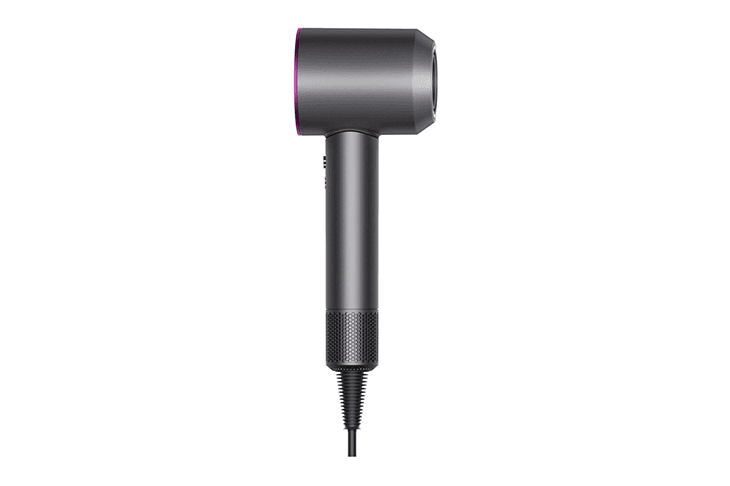
The "Dyson Supersonic Ionic," which debuted in 2016. The "hole" gaping right through its center is more than just a design choice. It's proof that, for the first time, the tool we call a hair dryer truly "applied science to airflow."
| The Motor Moves "Into Your Hand." A Center-of-Gravity Design That Makes Weight Disappear

image kikito
The reason conventional hair dryers feel heavy and tire your arms is that they're "top-heavy." Because the heavy motor sits up in the head, the principle of leverage puts strain on your wrist.
To solve this problem, Dyson developed the "Digital Motor V9," an ultra-compact, ultra-high-speed motor. And then they tucked that tiny motor away inside — of all places — the "handle." With the center of gravity right at your grip, it feels far lighter than its actual weight, and maneuverability improves dramatically. You can direct the airflow freely, almost as if you were holding a microphone.
| Blowing Water Away with "Air Pressure," Not Heat
image Sofmap
When drying their hair, most people try to evaporate the moisture with "heat." But excessive heat denatures the proteins in your hair and is the single biggest cause of damage.
Dyson's approach is the complete opposite. Instead of relying on "heat," it blows the moisture away with powerful "air pressure" like a jet engine. Its "Air Multiplier" technology amplifies the air it draws in by a factor of three, generating a high-speed airflow exceeding 100 km/h. Drying fast even at low temperatures. That was the only correct answer for protecting shine without damaging the hair.
| Temperature Checked 20 Times a Second. A Brain That Won't Burn Your Hair
image DEPACO
It's not just air pressure — temperature management is just as thorough. The "Intelligent Heat Control" feature uses a glass-bead thermistor to measure the air temperature more than 20 times per second and report it to a microprocessor.
This prevents the air from ever getting hotter than the set temperature, and stops your hair from becoming "over-dried." Even if you bring the dryer too close to your hair, the temperature drops automatically, so your scalp never gets hot. It isn't just a machine that blows air — it has a computer built in that's constantly assessing the situation.
| Magnetic Attachments. The Satisfying Snap of a Perfect Click
image value
The attention to detail in the accessories borders on obsessive. The attachments — nozzles, diffusers, and the rest — all attach magnetically. Just bring one close and it snaps into place with a satisfying "click," and you can rotate it a full 360 degrees freely.
No twisting, no force required. Even when you want to change the angle slightly mid-styling, you can adjust it smoothly with a single finger. It's exactly this intuitive feel that elevates the "class" of a tool you use every single day.
| In Summary: Is It Worth 40,000 Yen? An Investment in Buying Back Your Daily Time
image value
The price runs from 40,000 to 50,000-something yen. Almost everyone is shocked at first by a price tag nearly ten times that of a typical hair dryer. But consider that it's something you use every single day.
If your hair-drying time is cut in half, that adds up to dozens of hours saved each year. If hair damage decreases, you may even save on salon treatments. And above all, every post-bath ritual transforms from "an annoying chore" into "an experience that makes your hair beautiful." Once you've known that value, you can never go back to a hair dryer without a hole.