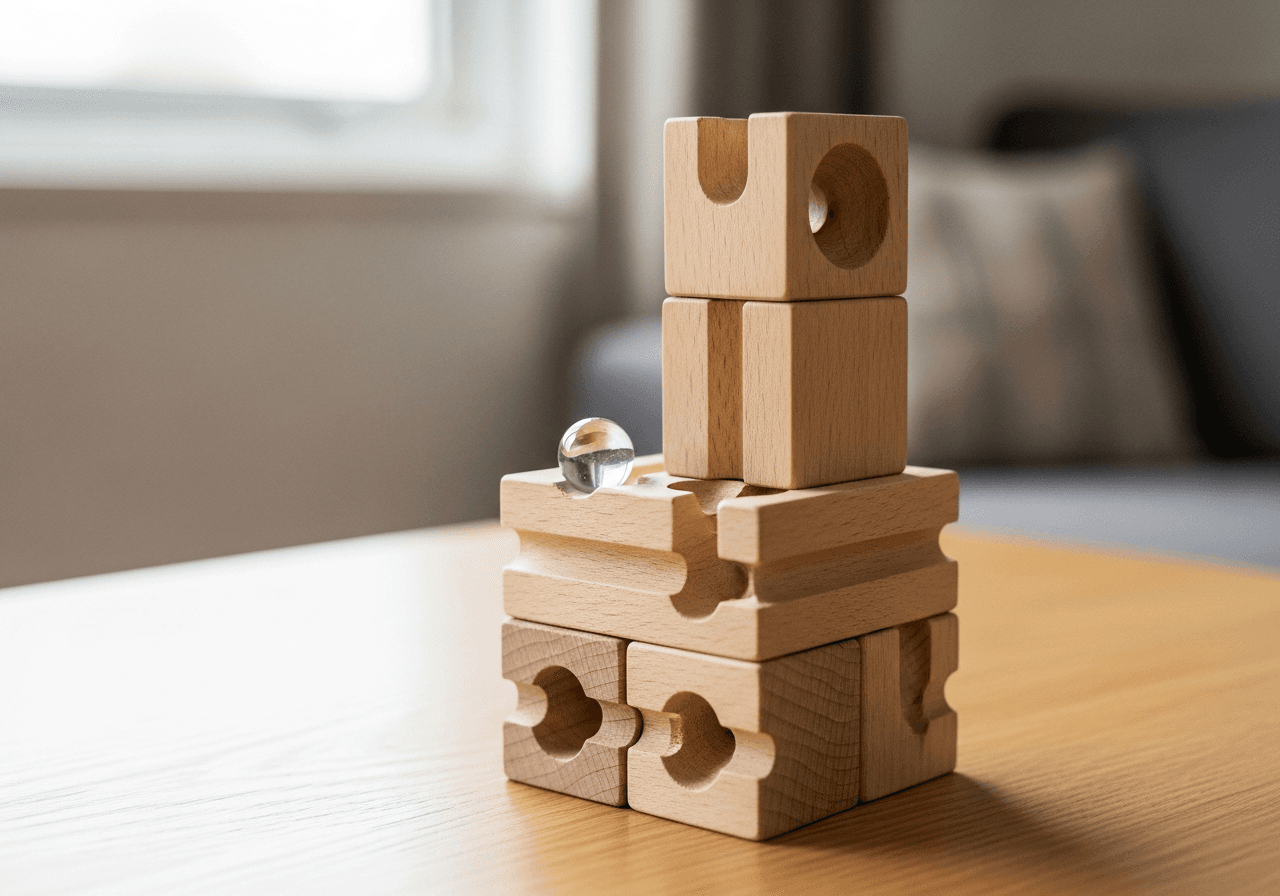
Say "kendama" and most people picture the same thing: three stacked cups and a spike. What we're introducing today quietly upends that assumption.
Called "Meteor," this kendama has a cup structure that isn't the usual circular shape but an asymmetric, irregular silhouette. At a glance, it's hard to even tell which part is the cup and which is the spike. And yet, once you set the ball down, it still lands exactly where it's supposed to.
The world of competition kendama is, in fact, governed by fairly detailed specifications. This odd shape was born outside that frame, and it reveals just how much room for play still exists within the toy itself.
Breaking the "form" reveals what the play actually is
Breaking the kendama's silhouette paradoxically brings into focus what "kendama-ness" really consists of.
A standard wooden kendama arranges its four catch points — big cup, middle cup, small cup, and spike — symmetrically. A distorted kendama like Meteor deliberately breaks that arrangement, scattering the height and angle of each catch point. The result: the range of trajectories that succeed for the same trick narrows, forcing you to rethink how you move your body from scratch.
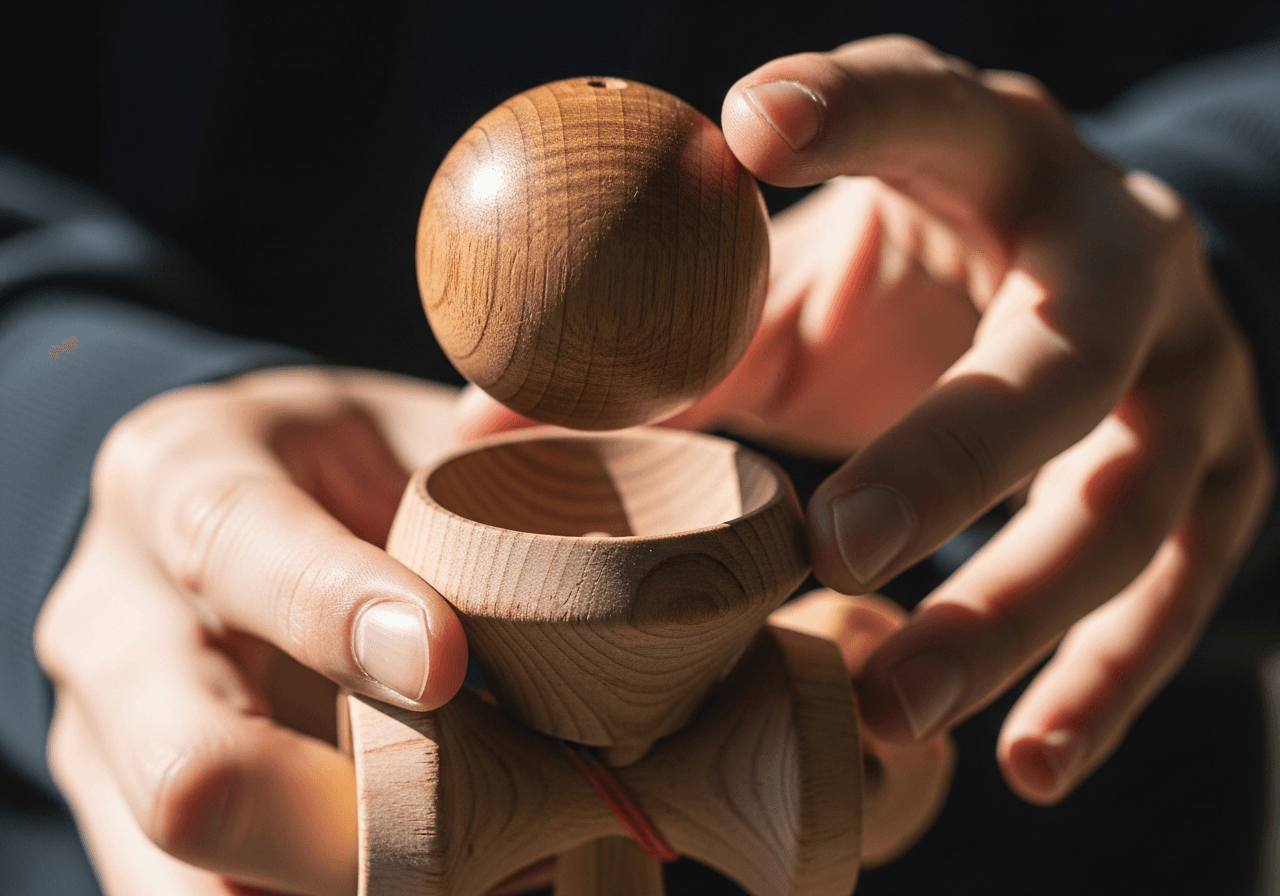
Visual impact and difficulty are two separate things
- Despite the eccentric look, basic tricks (moshikame, big-cup catch, spike catch) are designed to still work
- The ball and string length stay close to a standard kendama
- The distinctive look makes it easier to share on social media
Even with its attention-grabbing shape, the play itself still functions properly as "kendama" — which is probably why it doesn't end up as just a novelty item.
One toy, two ways to play
A distorted kendama's appeal lies in showing off and mastering coexisting in the same object.
A regular kendama is mostly played as a tool aimed at improvement, but a shape like Meteor's carries a different kind of value too — just owning one becomes a conversation starter. The way it works as an object on a shelf, simply by sitting there, is something ordinary toys rarely pull off.
How it actually gets enjoyed
- Redoing a familiar trick on a distorted kendama, just to feel how the difficulty shifts
- Displaying it as room decor and letting it spark conversation with guests
- Sharing it on social media, using the visual impact as the hook
Function as a tool, and presence as an object — reconciling both is probably why this kind of distorted kendama keeps getting talked about.
Closing thoughts
Break the form, and the essence of play comes into sharper focus, not blurrier. The idea of nudging the ordinary slightly out of place has something to say to everyday goods, too. At Yadom, we're always thinking about whether a small shift to an ordinary gesture — swiping on scent, holding something close — can open up a new way to use it. Perhaps the tools we're most used to are exactly the ones worth questioning the shape of.