Written by: Jin Fujisaki / Published: 2026-02-17
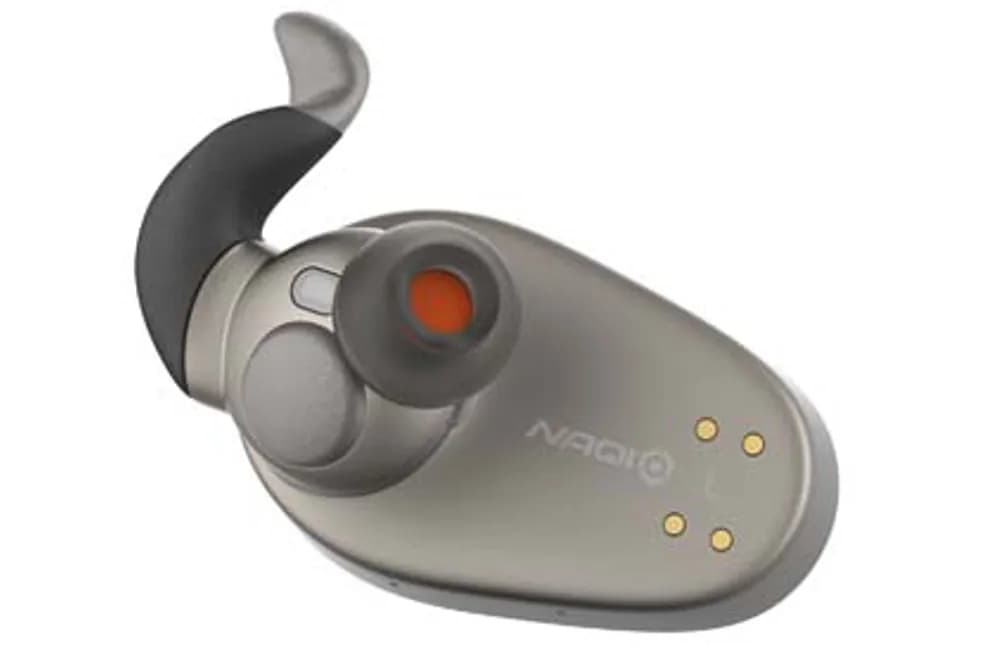
You're packed into a rush-hour train, gripping the strap, and you want to use your phone. But your hands are pinned, and you can't exactly start talking out loud. These black earbuds solve that very modern dilemma. Meet the "Naqi Neural Earbuds." They look like an ordinary pair of premium wireless earbuds, but inside, they're a dense cluster of sensors that read your intentions.
Put them on, and tense your jaw ever so slightly. Or blink in a way no one can see. That tiny biosignal — a micro-gesture — is enough to scroll your screen or launch an app. To everyone around you, you look like a statue quietly listening to music. But inside your head (and in the digital space) you're firing off messages and browsing the web at lightning speed.
| No Holes in Your Skull. The Reassurance of "Non-Invasive."

image CES
When you hear "brain-machine interface" (BMI), you probably picture something like Elon Musk's Neuralink — surgery to drill into the skull and implant a chip. Naqi, however, is non-invasive. No surgery required. You just slip them into your ears.
The ear canal sits close to the brain and is a treasure trove of electrical signals from the facial muscles and nerves. Naqi reads multiple inputs from this single location: subtle head movements via a gyroscope, muscle activity via EMG, and brain waves via EEG. The sheer relief of "you don't have to implant anything" is what's pulling this technology out of the niche enthusiast crowd and into the mainstream. When the battery dies, just drop them in the charging case. There's no need to become a cyborg.
| The FPS Gamer's "Third Hand." Reload With a Thought.

image TechTrek
The device was met with wild enthusiasm in one world in particular: esports. When both your hands are tied up on the controller, hitting "reload" or "weapon swap" costs you fractions of a second. With Naqi, a light clench of the teeth is all it takes to reload.
Because you're issuing the command at a point closer to your brain than your fingers can reach, the response time is uncanny. "I shot the moment I saw the enemy." Hardware now backs up that kind of next-generation reflex. The earbuds also pair beautifully with VR (XR) headsets — walking through a virtual space without holding any controller takes immersion to another dimension.
| Liberation From Full-Body Paralysis. True Accessibility.

image Entrepreneur
Naqi's true goal is to help people with physical disabilities live independently. Even someone who can't move their arms or legs due to injury or illness can freely operate a PC or wheelchair, as long as they can twitch a facial muscle or shift their head by a millimeter.
It's less fatiguing than eye-tracking input, and far more private than voice input. "I can pick a YouTube video and message a friend on LINE, on my own, without anyone's help." What's mundane to able-bodied users is, for them, a kind of magic — the moment technology truly stands in as an alternative for lost physical function.
| In Summary: Humanity Graduates From "Fingers"

image Neozone
The price is roughly the cost of a few pairs of high-end earbuds (around 100,000 yen). But what you get in return is a wizard's wand.
Ever since the smartphone arrived, we've been chained to tapping a screen. The Naqi Neural Earbuds cut that chain. Whether you're cooking, driving, or even bedridden — the interface that connects you to the world now lives inside your ear. So the next time someone replies to you without moving their hands or their mouth, don't be surprised. For Naqi users, that's just everyday life.