A single string and a single weight. Few toys pack so many tricks into such a simple, one-dimensional up-and-down motion as the yo-yo.
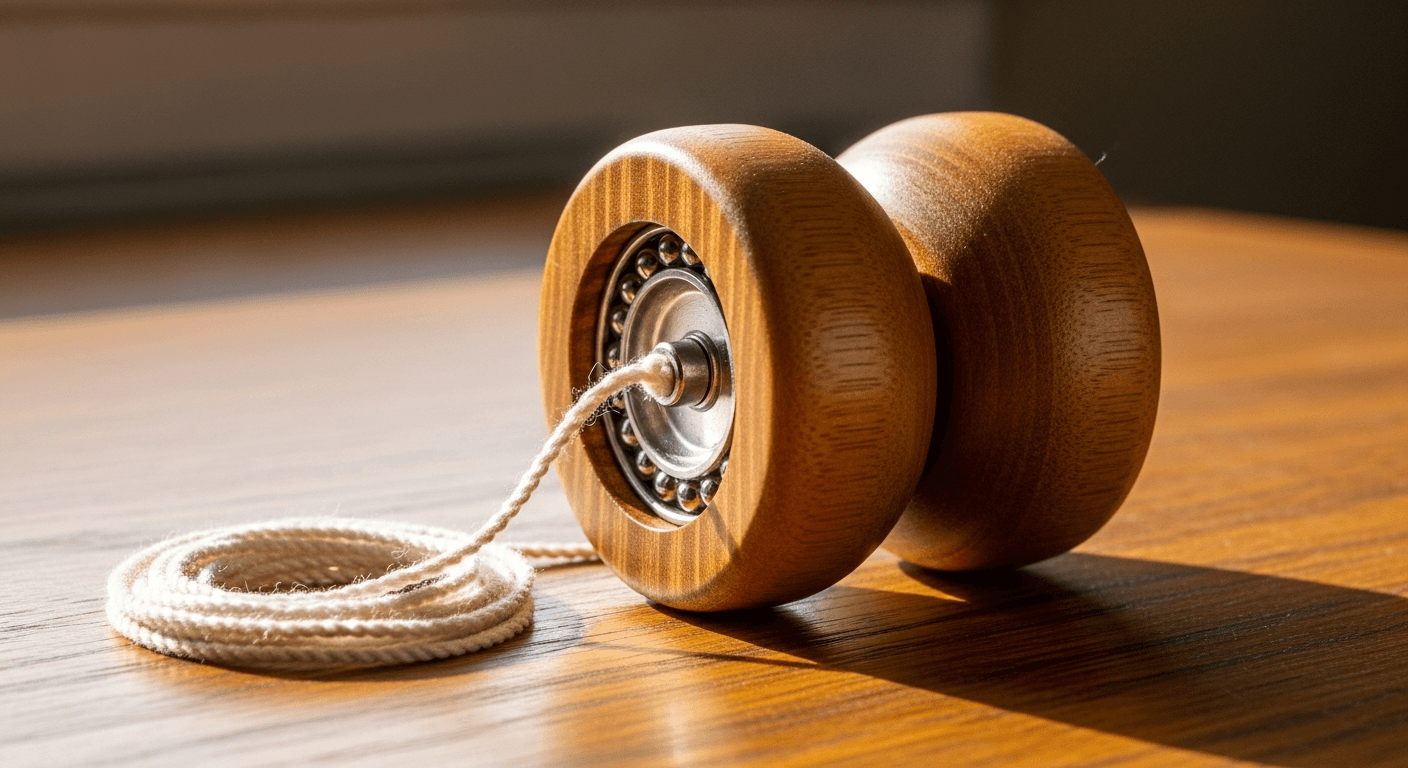
The outward shape has barely changed, yet the mechanism inside has quietly evolved. The shift from a "fixed axle," where the string is tied tightly to the axle, to a "ball-bearing axle," where the string is loosely wound around a bearing, marks the biggest turning point.
When the string is fixed to the axle, all you get is a simple up-and-down motion. The moment the axle could spin independently, the yo-yo gained a completely different behavior: staying near the ground while still spinning.
From Fixed Axle to Bearing Axle
Changing from "tying" the string to "winding" it opened up a whole new range of possibilities.
Traditional fixed-axle yo-yos have the string tied firmly to the axle. They can move up and down, but since the string and axle rotate as one, it's hard to keep the yo-yo resting at the bottom for long.
Bearing-axle yo-yos, by contrast, separate the rotation of the string from the rotation of the axle. Even after the yo-yo drops to the bottom, the body keeps spinning on its own momentum for a while. This state of "appearing still while still spinning" became the foundation for later tricks.
The Difference Between the Two Axles
- Fixed axle: string and axle rotate together. Simple structure, mainly up-and-down motion
- Bearing axle: string and axle rotate independently, extending the "sleep" time at the bottom
It's less that one is superior and more that they're tools built for different purposes.

Tricks That Start From "Still, Yet Spinning"
That brief moment of stillness called the "sleep" is what makes complex string tricks possible in the first place.
While the yo-yo rests at the bottom holding its spin, the body looks almost motionless. During those few seconds of "sleep," the player forms loops with the string, passes the body through them, or hooks the string on a finger to create new paths. This is the basic principle behind so-called "string tricks."
The tension of the string alone can change how difficult a trick is. Too tight, and the string tangles and pulls the body back; too loose, and the sleep time shortens. Performers constantly fine-tune the string tension by feel.
Beyond Simple Up-and-Down Motion
- The basic up-and-down motion
- Holding the spin at the bottom and forming loops with the string
- Passing the body through the loop to change its path
Building on this progression is a whole world of yo-yo play systematized into competition. The fact that international contests are held on an ongoing basis is itself evidence that this one-dimensional toy carries real depth.
Why the Simple Shape Hasn't Changed
The mechanism inside has evolved, but the outward form — a disc and a string — has barely changed.
Materials and bearing precision have improved over the years, but the basic form of "a weighted disc" plus "a single string" remains remarkably consistent. That simplicity is precisely why children and seasoned players alike can pick up the same tool.
Whether to chase elaborate tricks or simply swing it up and down is left entirely to the player. The tool itself doesn't rule out either way of playing.
THE YADOM, in its own way, shares a similar idea: leaving room for how something gets used, rather than locking it into one correct method. A tool with only one right answer rarely lasts — the ones that leave space for the user's own hand tend to stick around longer.