Written by Jin Fujisaki / Published: 2026-01-13
Do you think building blocks are just for stacking and knocking down? Sure, simply stacking or arranging cubes is fun on its own, but certain building blocks open up a world far beyond that.
Known for being the blocks that shogi player Sota Fujii reportedly played with as a child, Cuboro — these aren't just "wooden pieces for stacking." They are a tool that gives shape to the time you spend thinking.
| What is Cuboro?

image NEXUS
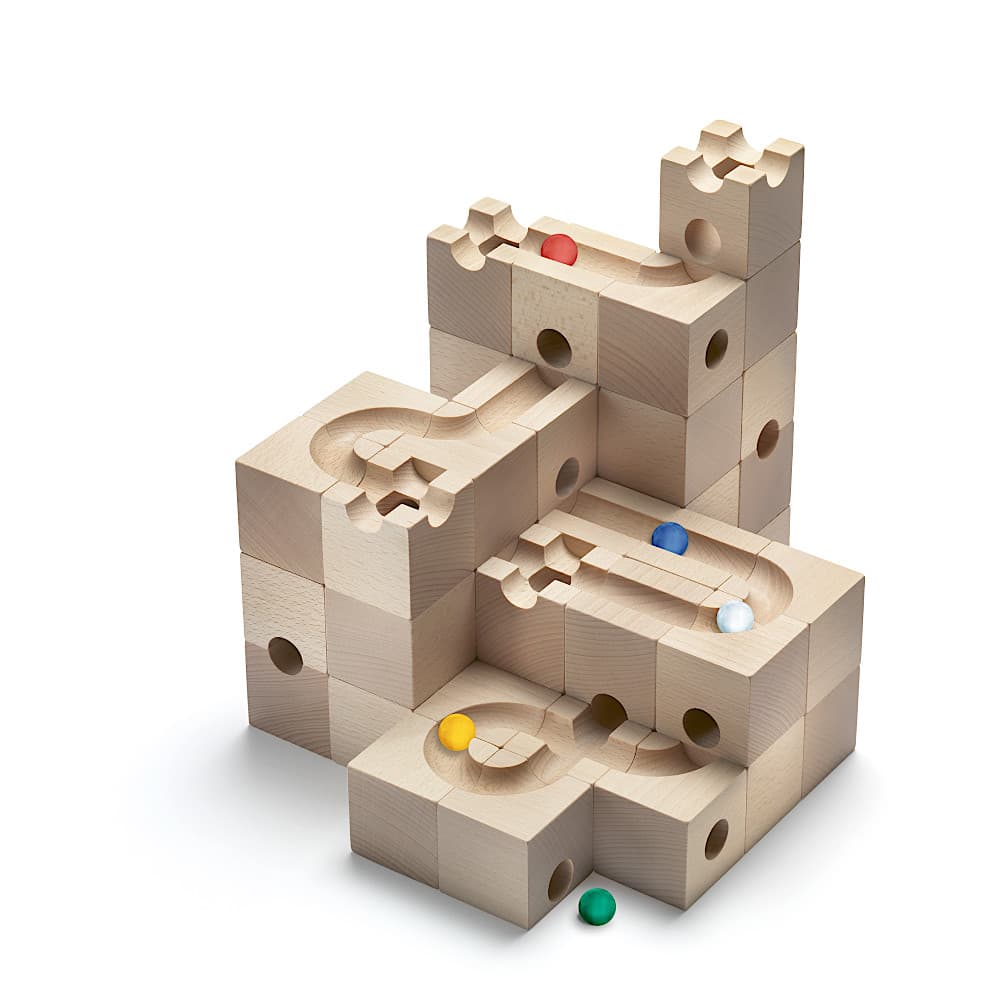
Cuboro is a set of structural building blocks that combines cubic pieces with grooves and holes. Although they look simple, the grooves running through them and the hollow openings inside let you build "mechanisms" that send balls or small spheres rolling through them.
It's not just about stacking; the play involves designing the very paths the ball will travel. This goes beyond ordinary children's play — it's a structure that nurtures logical, systematic thinking.
| Why Did Sota Fujii Play With It?
image ysh
In stories about Sota Fujii's childhood, there are accounts of him playing with Cuboro as a kind of "three-dimensional structural puzzle," and this is sometimes cited as something that helped shape his thinking abilities.
There are several reasons why this might be the case.
- The outcome changes depending on how you stack the blocks
- You have to think out the path the ball will roll along yourself
- It's a continuous process of trial and error
- It requires you to look ahead and plan
These overlap with the ability to read ahead and grasp structure that shogi demands — a shared underlying thought process.
| A Design Where Mechanism Connects Directly to Play
image SALALA
Cuboro is far from being just a set of cubic blocks.
The blocks include the following elements:
- Pieces with holes running through them
- Pieces with grooves
- Pieces that act as tunnels
- Pieces that can connect to one another
By arranging these in three dimensions, you can build "paths for a ball to roll along."
As a result, instead of simple stacking play, it becomes a game that engages with themes such as:
- Spatial arrangement
- Path design
- Setting a starting point and an end point
- Understanding gravity
| Free, Deep, Three-Dimensional Play
image Ptashka
There's no fixed way to play with Cuboro. Starting from the basic set and adding more pieces, you can design ever more complex structures.
◎ Rolling the Ball
At first, you plan where the ball will start and where it will end up.
◎ Building Complex Routes
By combining grooves and holes, you can create curves and branching paths.
◎ Setting Goals
"The shortest route." "The most complex structure." "A mechanism where, once the ball rolls, it never returns to the start."
You can also play by setting your own rules like these. It's truly an experience that brings the cycle of creation and verification to life.
| Why Does It Have to Be a "Building Block"?
image Your Main Line
The reason Cuboro works purely as a set of building blocks comes down to:
- Moving your hands trains your spatial awareness
- There's a process of failing, trying again, rebuilding, and retrying
- The visible results come back to you instantly
— in other words, a coupling of physicality and cognition.
Unlike a puzzle confined to a screen, it creates an experience of thinking with your hands.
| Who Is It For, and When?
image kaaviyahome
Rather than being just a children's toy, Cuboro is a product whose value lies in being a tool that nurtures thought.
- People who want to think in three dimensions
- People who want to build experience in reading ahead
- People who want to repeat cycles of creation and verification
- People who want to treat the design of thought as play
Of course, it's also great for parents and children to play with together. When adults think alongside the child and engage in their small "trial and error," it gives rise to an exchange of thought as well.
| Summary | The Intersection of Play, Structure, and Thought
image Lasbardenas
So, what did you think?
Cuboro is not just a set of building blocks. This collection of cubes with their holes and grooves is a tool that gives three-dimensional form to the very structure of thinking.
"Think before you look," "move your hands before you think" — this simple chain strengthens thinking as a lived experience.
The anecdote about Sota Fujii encountering it in childhood isn't just a marketing hook; it stands as a primal experience of the ability to read ahead.