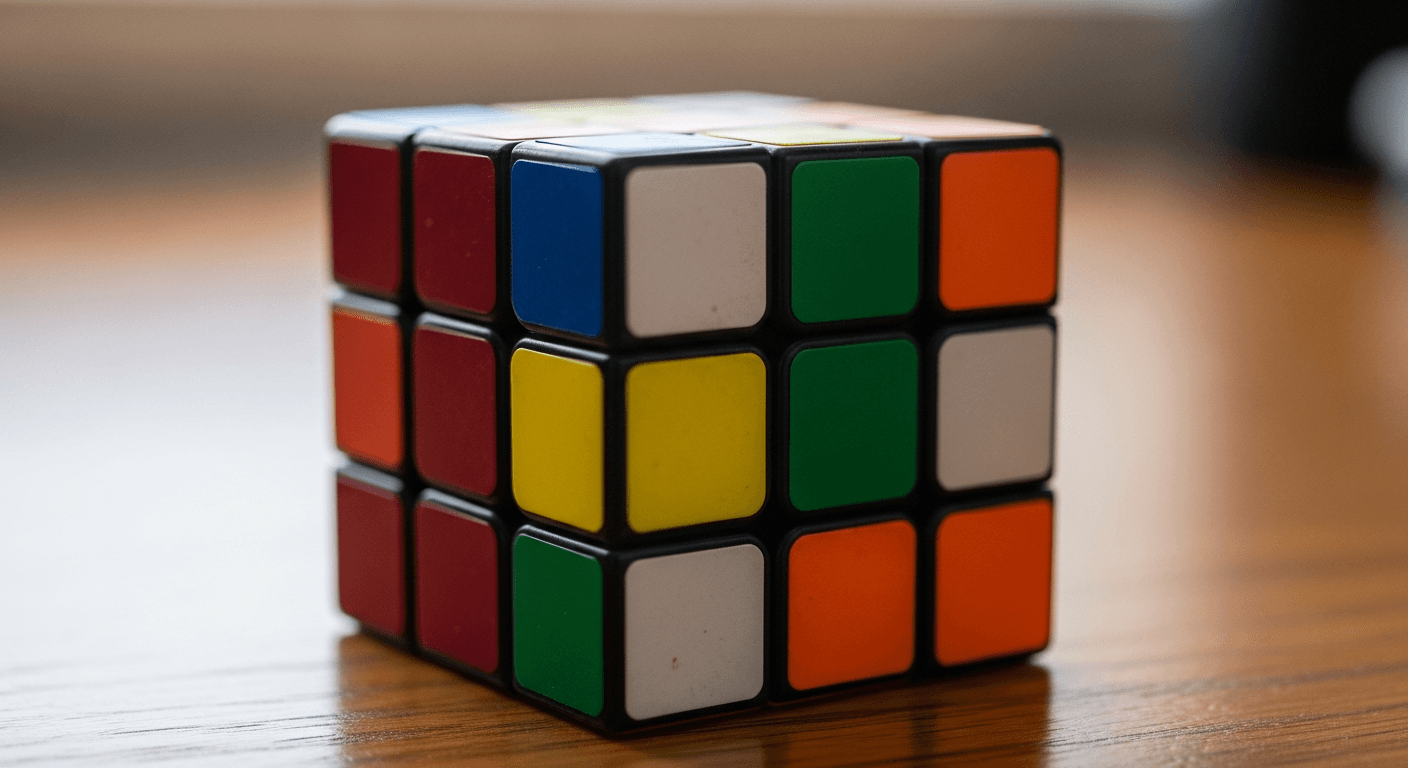
Six faces, six colors, and a near-infinite number of combinations. The Rubik's Cube spread around the world less because it was a complex mathematical puzzle, and more because its shape simply invited people to pick it up and start twisting.
Every twist swaps the colors around, and no one can tell at a glance how many moves it will take to get them all back in order. That very uncertainty is probably why it has stayed popular for so long, both as an educational toy and as a puzzle for testing logic.
Break down the internal structure, though, and it's not actually that complicated. Each face's pieces rotate independently around a central axis, and the corners are rounded off just enough that adjacent faces don't interfere with each other. That single design choice is what produces the smooth, satisfying feel of each turn.
The Visual Goal of Matching Colors
There are established methods (algorithms) for solving it correctly, but for a first-time player the goal boils down to one simple thing: match the colors.
Part of what makes the Rubik's Cube compelling is how clear the goal is. "Make each of the six faces a single color" is understandable at a glance, no rules required. Puzzles that work purely on sight, without needing to decode numbers or symbols, are surprisingly rare.
At the same time, the actual solving process has been systematized. Some solve layer by layer from the top down; others memorize fixed sequences of moves (algorithms) to complete large chunks at once. Multiple approaches exist.
Where the Difficulty Comes From
- Because each face rotates independently, a single move changes the colors on several faces at once
- The constraint of solving one face without disturbing a face you've already matched raises the difficulty
- Learning the sequences systematically lets you solve faster than relying on intuition alone
In other words, this isn't a puzzle solved by luck — it's one solved through understanding a method, and that's exactly what keeps people coming back to it.
Expanding Toward Speed
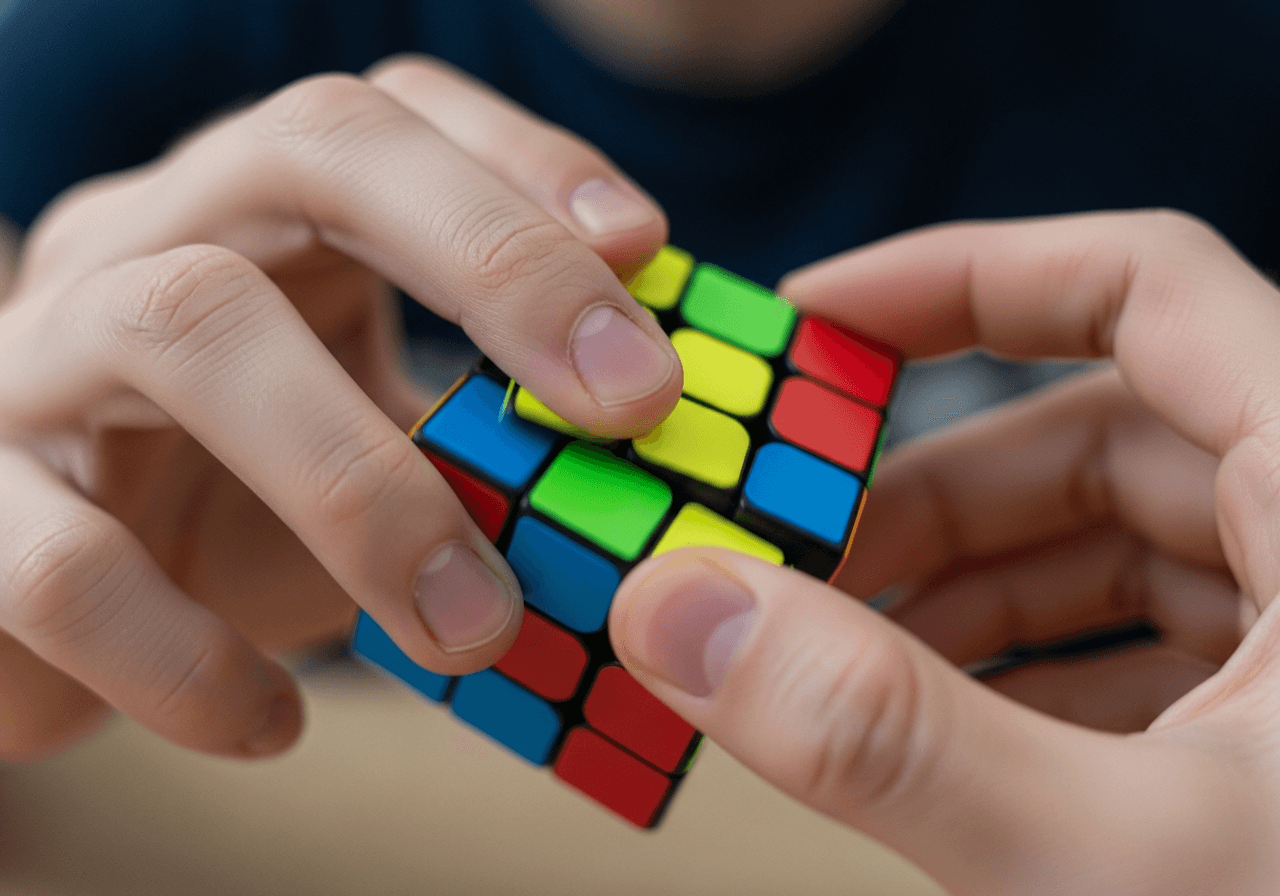
Beyond simply solving it, play has expanded in another direction: how fast can it be solved?
Once someone learns to solve the cube, some move on to chasing speed. How smoothly and efficiently a fixed sequence of moves can be executed has become another entire way to play with the same object.
- First, aim to match the colors
- Once you can solve it, learn the sequences systematically
- As you get comfortable, start paying attention to speed
The very same cube becomes, for a beginner, a challenge of "can I solve it at all," and for an expert, a challenge of "how fast can I solve it." That layered depth is probably why it hasn't grown stale even decades after its release.
Depth Hidden Inside a Simple Shape
The shape never changes, yet how it's played changes entirely depending on the player's level.
The Rubik's Cube feels less like a puzzle that's simply "hard" and more like a tool with a carefully built staircase of play. Someone picking it up for the first time and someone who has solved it hundreds of times are holding the exact same cube.
THE YADOM aims for something similar: a tool that doesn't dictate how it should be used. Something that isn't tied to a single correct answer, and that meets each person at their own pace, tends to be the kind of thing that stays with you for a long time.